Bristol Myers Squibb expands NVIDIA-backed AI supercomputer to accelerate drug discovery
Published by AINave Editorial • Reviewed by Ramit
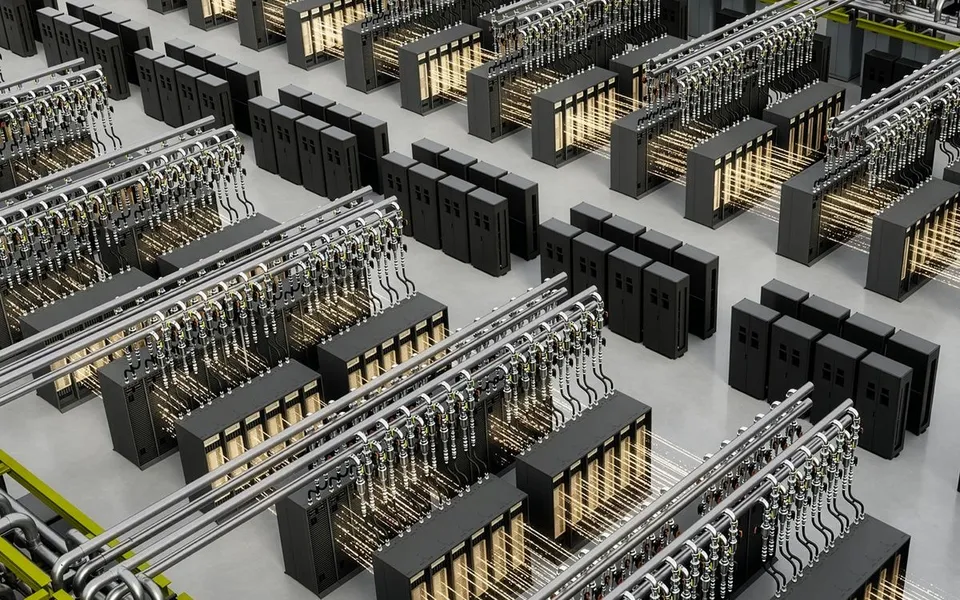
Bristol Myers Squibb (BMS) is expanding its AI compute infrastructure with a new NVIDIA DGX SuperPOD built on eight DGX Vera Rubin NVL72 systems, claiming it as the most powerful and energy-efficient AI cluster in the life sciences industry. The move signals a shift from narrow AI tools to foundation-model-enabled insights for drug discovery, with initial focus on oncology and neurodegeneration.
What happened
BMS announced it is deploying its second NVIDIA DGX SuperPOD, this one built on eight DGX Vera Rubin NVL72 systems. The company began its partnership with NVIDIA three years ago with a smaller computing cluster focused on simpler problems like protein structure prediction. But according to Greg Meyers, BMS chief digital and technology officer, the company "consumed all the space we had" and needed more compute to run computationally hungry foundation models that can give insight into how drug candidates interact with the body and disease https://www.statnews.com/2026/07/20/bms-nvidia-assembling-largest-pharma-ai-supercomputer/.
This is the third time in nine months that a pharma company has announced it is assembling the largest AI supercomputer in the life sciences industry https://www.statnews.com/2026/07/20/bms-nvidia-assembling-largest-pharma-ai-supercomputer/. The previous smaller SuperPOD system BMS bought from NVIDIA is around two or three generations behind Vera Rubin https://www.bnnbloomberg.ca/business/2026/07/20/bristol-myers-buys-nvidias-latest-ai-computing-system-for-drug-research/.
Why AI builders should care
For teams building AI products in regulated industries like pharma, this deployment shows that large-scale compute infrastructure is becoming a prerequisite for foundation-model-driven research. BMS is moving beyond single-task models (e.g., protein folding) toward multi-modal foundation models that analyze drug interactions across biology, chemistry, and clinical data. This requires the kind of dense GPU clusters that NVIDIA’s Vera Rubin platform provides, succeeding the Hopper and Blackwell architectures https://asibiont.com/en/blog/bristol-myers-squibb-stroit-samyy-peredovoy-ai-zavod-v-biofarme-chto-takoe-vibe-coding-na-baze-nvidia-vera-rubin.
AI builders working with biopharma clients should expect growing demand for custom model training, fine-tuning, and inference pipelines that can run on proprietary data. The trend also means that cloud-based AI services may face competition from on-premise or hybrid AI factories as pharma companies seek data sovereignty and low-latency compute for sensitive research.
Practical implications
BMS’s expansion creates opportunities for AI builders in several areas:
- Model development: Foundation models trained on biological and chemical data need massive compute. BMS’s new cluster can support training runs that were previously infeasible.
- Inference at scale: Once models are trained, running inference on millions of drug-target interactions requires sustained throughput.
- Integration with existing pipelines: BMS will need tools to connect AI outputs with its drug discovery workflows, from target identification to clinical trial design.
However, the infrastructure is purpose-built for BMS’s internal research. External AI builders may find it harder to access such compute unless they partner directly with pharma companies or build similar capabilities in the cloud.
Caveats
The claim of being the "most powerful" AI cluster in life sciences comes from BMS and NVIDIA announcements, not from independent benchmarks https://endpoints.news/bristol-myers-nvidia-say-theyll-build-most-powerful-ai-supercomputer-in-pharma/. Other pharma companies have made similar claims recently, so the competitive landscape is shifting quickly. No specific performance numbers, cost, or timeline for full deployment were provided in the available sources. The previous BMS cluster was several generations behind, so the actual uplift in model capability will depend on how well BMS adapts its workflows to the new hardware.
Sources
- Bristol Myers Squibb becomes latest company to claim it’s building pharma’s largest NVIDIA AI supercomputer
- Bristol Myers Squibb Building Life Science Industry’s Most Advanced AI Factory on NVIDIA Vera Rubin | NVIDIA Blog
- Bristol Myers Squibb expands NVIDIA AI supercomputer for drug discovery
- Bristol Myers says it will build pharma's 'most powerful' AI supercomputer with Nvidia
- Bristol Myers Squibb Builds Custom Nvidia Supercomputer - Yesil Science
- Bristol Myers buys Nvidia's latest AI computing system for drug research
- Bristol Myers to build ‘powerful’ AI factory; Samsung Biologics bids for peptide maker
- Pharma giant Bristol Myers Squibb boosts AI capacity with Nvidia...
- Bristol Myers Expands NVIDIA Partnership to Build Top Life Sciences...
- Bristol Myers Squibb Building Life Science... — ASI Biont Blog
- Bristol Myers Squibb (BMY) Expands AI Capabilities with Nvidia S
- Bristol Myers Nvidia AI deal
- Bristol Myers Squibb Deploys AI Supercomputer for Drug Discovery...
- Bristol Myers Squibb's value appeal
- Bristol Myers Squibb vs. Johnson & Johnson: Which Healthcare Stock Is a Better Buy in 2026?