Liquid AI d1 Turns Fixed-Choice Questions Into Probabilities
Published by AINave Editorial
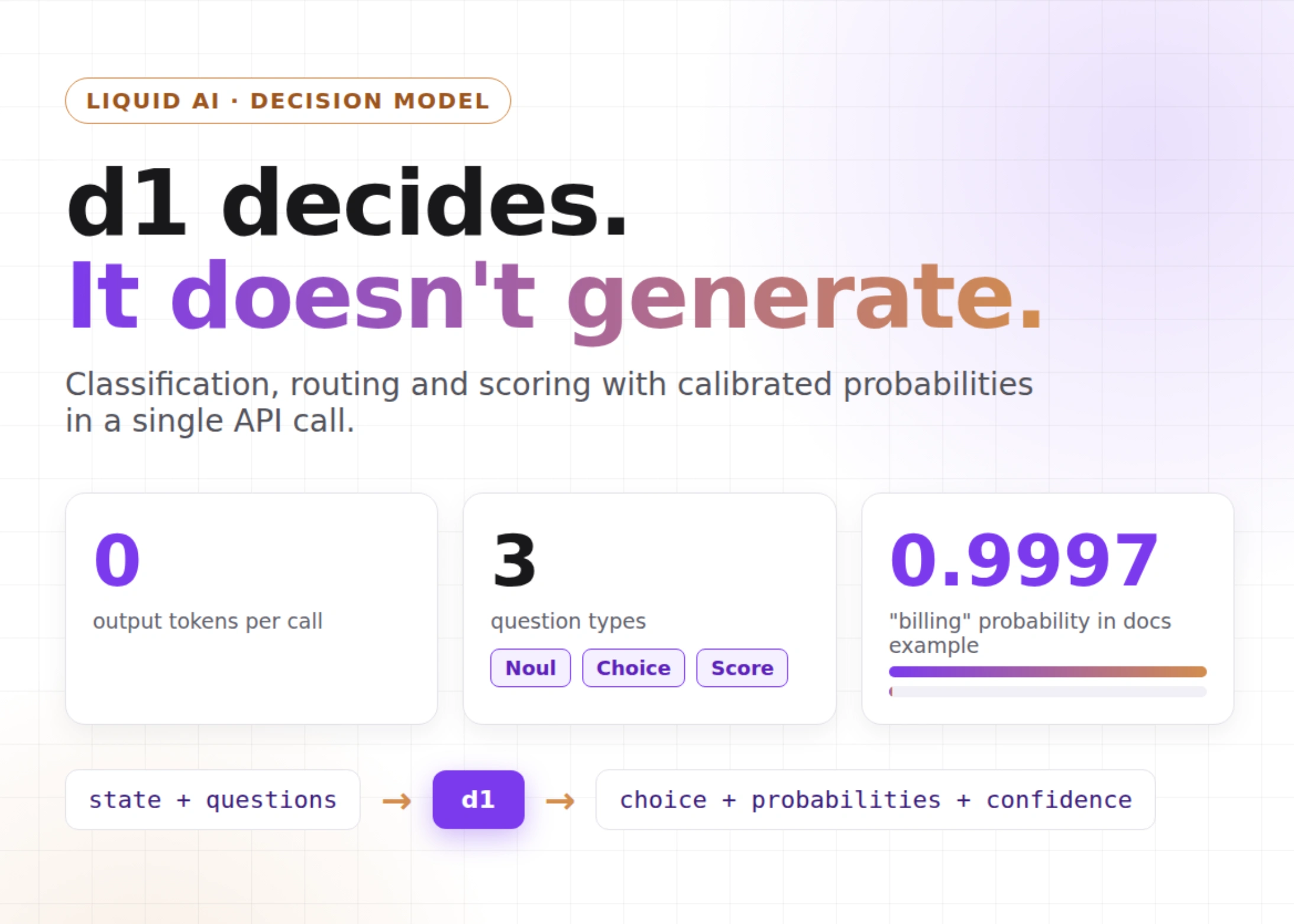
Liquid AI’s d1 decision model is built for cases where software already knows the possible answers. Give it context and typed questions, and it returns probabilities for the defined outcomes in one call, with zero generated output tokens, according to the release coverage. That makes d1 a different kind of tool from a general-purpose LLM: it selects or scores rather than composing a response.
The distinction matters in pipelines that ask a model to choose among labels or actions. Liquid positions d1 for classification, ticket routing, moderation, reranking and evaluation of other models. Those are intended use cases, not independent evidence that d1 outperforms an existing classifier or LLM.
Three ways to express a decision
The model supports three question types. Noul handles yes-or-no questions and returns a probability. Choice selects from named options, with a distribution across them. Score rates an input on an ordered rubric. Liquid says developers can combine all three in one request, evaluated against the same context in a single round trip.The reported examples include a complaint probability of 0.999, a billing choice score of 0.9997 and a production-outage score of 2.9995. They illustrate the output formats, not benchmark performance.
| Question type | Output | Example use |
|---|---|---|
| Noul | Yes/no probability | Check whether a message is a complaint |
| Choice | Named option and outcome distribution | Route a ticket to a category |
| Score | Position on an ordered rubric | Rate urgency |
Probabilities also give downstream systems a way to represent uncertainty. In Liquid’s moderation example, a score above 0.8 blocks content, below 0.2 allows it, and the middle range goes to human review. Its routing example sends low-confidence cases below 0.5 to a more capable model tier.These thresholds are examples from Liquid’s coverage, not general-purpose settings established by an independent evaluation.
The trade-off is a hosted decision layer, not a replacement LLM
The report describes d1 as available through Liquid’s API under the model name d1:free, with Python and TypeScript clients. It is API-only and not trainable, with no GGUF, MLX or ONNX weights for self-hosting.Those access constraints matter for teams that need to keep inference on their own infrastructure or adapt model weights.
Zero output tokens describes the response format, but it does not by itself establish lower total cost for a workload. The supplied coverage gives no paid rates, independent calibration study or comparative benchmark for latency and quality. The probability outputs may make threshold-based routing easier to express, but their usefulness depends on how well they match real-world outcomes.
For a bounded decision, d1’s fixed outputs can avoid asking a generative model to produce a label as text. For summarization, drafting, chat, code generation or complex multi-step reasoning, the same coverage recommends keeping a generative LLM. The practical split is therefore about what the system must return: a choice from known outcomes, or new content.