How Hyperscalers Are Rebuilding AI Infrastructure Around Compute, Power, and Water
Published by AINave Editorial • Reviewed by Ramit
The hyperscalers driving AI infrastructure are planning more than $700 billion in AI computing investment during 2026. For AI builders, the immediate benefit is access: a small team can rent advanced compute instead of building a data center. The tradeoff is that the same expansion is concentrating infrastructure, chip supply, power demand, and operational risk among a small number of providers.
Hyperscalers are becoming the control layer for AI deployment
A hyperscaler operates computing capacity across many data centers, using standardized hardware, automation, and large capacity additions. It may rent that infrastructure through cloud computing services or use it internally for products such as search, social platforms, and AI models. A data center is a facility; a hyperscaler is the company and operating model spanning many facilities.
The distinction matters when evaluating vendors. AWS, Microsoft Azure, and Google Cloud sell general-purpose cloud platforms. Meta and Apple also operate hyperscale infrastructure, but primarily to support their own products. Oracle Cloud Infrastructure is smaller than the leading three cloud platforms but is expanding around AI workloads. Alibaba Cloud and Huawei Cloud play major regional roles in China.
The market is concentrated, even as capacity expands
AWS, Azure, and Google Cloud together held about 63% of global cloud market share in the second quarter of 2026, according to the supplied reporting. AWS accounted for about 28%, Azure about 20%, and Google Cloud about 15%.The three providers dominate the cloud layer, which is the layer most product teams encounter when deploying models, databases, agents, and APIs.
That concentration lowers the barrier to launching an AI product. Teams can scale inference, storage, networking, and model training without owning specialized hardware. It also creates practical dependency. A regional outage, quota restriction, price change, or unavailable accelerator can affect a product long after its application code is stable.
For builders, the sensible response is not to avoid hyperscalers. It is to separate application logic from provider-specific assumptions where the cost or reliability of doing so justifies the effort. Keep model routing, data storage, observability, and fallback behavior explicit rather than burying them inside one managed service.
AI capacity is now a power and cooling problem
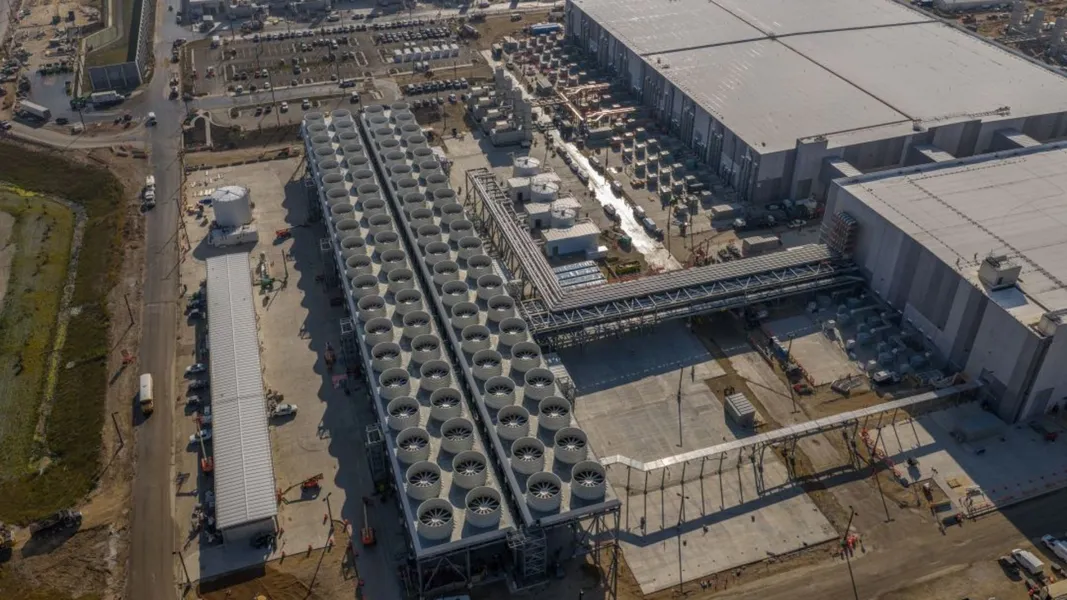
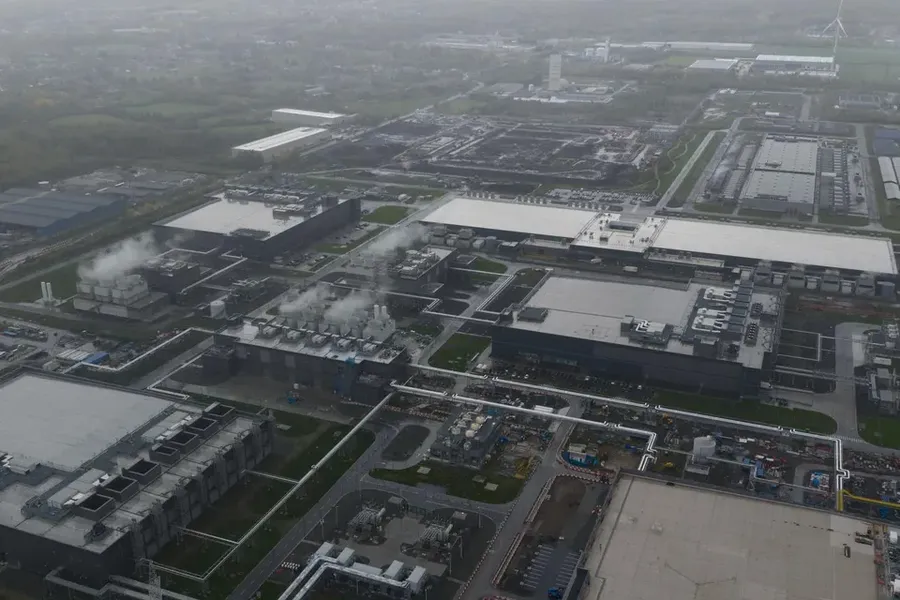
Modern AI workloads require dense clusters of specialized chips, including Nvidia GPUs and custom accelerators such as Google TPUs. Large campuses can draw hundreds of megawatts, while cooling can require millions of gallons of water per day. The reporting cites Google data centers in The Dalles, Oregon, which used about 355 million gallons of water in 2021, nearly a third of the city’s reported usage at the time.The physical requirements of AI data centers are substantial.
The scale of planned facilities illustrates the gap between software deployment and physical deployment. Switch’s Citadel campus is planned for up to 7.2 million square feet and approximately 650 megawatts. Meta’s Prometheus project in Ohio is described as reaching about one gigawatt across several buildings. A proposed Nvidia and OpenAI complex near Columbus has been discussed at roughly 10 gigawatts, but that figure is forward-looking rather than operating capacity.
This changes the economics for AI operators. Compute availability depends on grid connections, transformers, land, fiber, cooling design, and local approvals, not only on whether a model or GPU is technically available. Teams planning large inference workloads should treat regional capacity and deployment lead times as architecture inputs.
Local approval is part of the infrastructure stack
Hyperscaler expansion increasingly affects communities that must provide power, water, roads, and sometimes tax incentives. Tucson’s city council unanimously rejected Project Blue, a data-center campus tied to Amazon, in 2025 after concerns about resource use. That decision shows why a technically feasible project can still face a local deployment
Sources
- What Are Hyperscalers? The Companies Driving The AI Infrastructure Boom
- The $725 Billion Structural Trap: Who Actually Profits From the AI...
- Hyperscale Data Centers: What They Are, How... | Britannica Money
- GHPIAWhat Are Hyperscalers? AI Infrastructure Explained
- Inside the Infrastructure Behind the AI Boom | Money & Markets
- Hyperscalers: The Technology Backbone Powering the... | Medium
- CRWV’s deep NVDA integration makes it a go-to choice, says Morningstar — analysts say META's planned cloud move reinforces AI compute boom
- Hyperscaler stocks vs. AI infrastructure stocks: Which are the better buys?
- 4 Semiconductor Stocks to Buy Right Now to Ride on the AI Capex Boom
- Forget AI hyperscalers: Tesla may own the most valuable AI application
- Amazon just flipped the AI capex narrative
- A $700 Billion AI Infrastructure Bet: Where the Money Goes and What...
- Forget AI Hyperscalers: Tesla May Own the Most Valuable AI Application
- Chamath Palihapitiya Says the AI Boom May Be Hiding Biggest Capital Allocation Mistake in History
- If the AI boom is so strong, why are memory stocks crashing?
- AI investment boom puts Big Tech's free cash flow under pressure