Google Search connected apps: enabling in-search task completion with Instacart, Canva, and YouTube Music
Published by AINave Editorial • Reviewed by Ramit
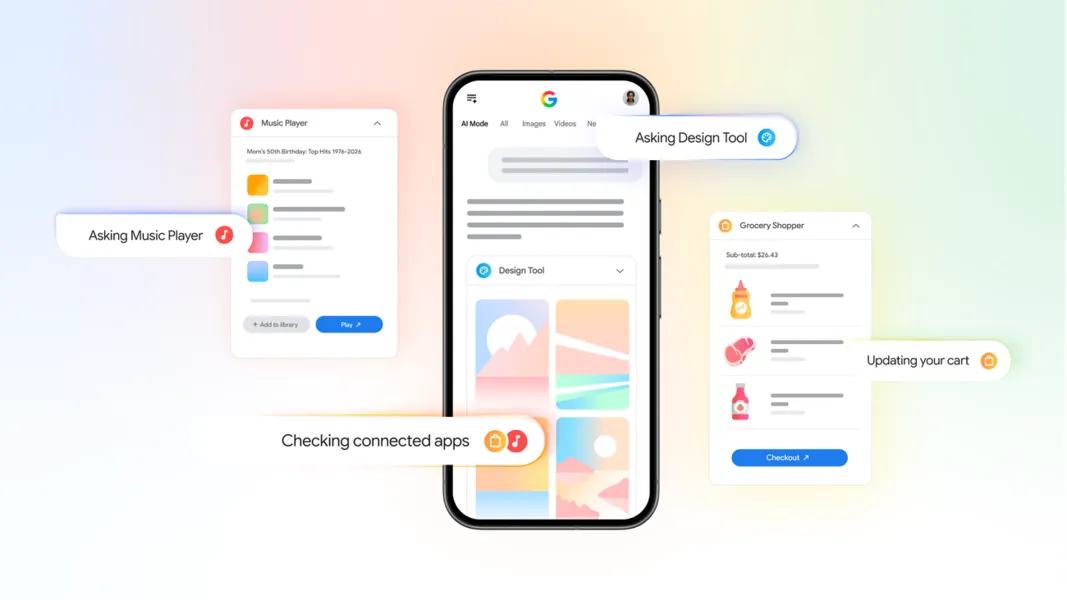
Google has started allowing users to link third-party apps directly to AI Mode in Google Search, letting them complete tasks without leaving the search results page. The first integrations with Instacart, Canva, and YouTube Music surface actions like adding groceries to a cart, choosing a design template, or saving a playlist right inside the search interface.
What happened
Google announced that AI Mode in Search now supports secure linking and interaction with select partner apps. Users can connect services like Instacart, Canva, or YouTube Music to perform tasks directly from the search page. For example, while planning a barbecue, a user can ask AI Mode for a grocery list and then add those ingredients to their Instacart cart with a few taps. Similarly, AI Mode can show Canva template options for a flyer project or curate a playlist and save it to YouTube Music. The rollout began this week in the United States, and Google says it is working with a range of partners to add more apps soon. This feature extends the connected apps capability that already existed in the Gemini app into Search itself.
Why AI builders should care
For teams building AI-powered products, this feature demonstrates a practical pattern for embedding third-party app ecosystems into a core experience. The ability to reduce context switching by keeping users inside a search or assistant interface is a powerful design choice. Google uses Personal Intelligence and connected apps to deliver more tailored responses as users stay within Search. Builders developing search, assistant, or agent workflows can study how these integrations surface actions without requiring users to open separate apps or copy-paste data. The use cases shown grocery shopping, design creation, and media curation represent common consumer workflows that could translate to enterprise or productivity products.
Practical implications
Developers interested in building similar in-search or in-assistant task completions should note the integration model Google has chosen: secure linking with explicit user consent, then direct action execution within the search results. While Google has not published an API or SDK yet, the pattern suggests a future where apps expose action endpoints that AI assistants can call. For now, the feature is limited to select partners, but Google says it looks forward to launching with more apps soon. Privacy and data sharing are handled through Google's existing privacy policy, though specific technical details about sandboxing, permissions, or token scope are not disclosed in the announcement. AI builders should watch for expansion beyond the U.S. and for potential developer onboarding pathways.
Caveats
This initial launch is U.S.-only with no announced timeline for other regions. The announcement relies on promotional language from Google and its partners, and no independent benchmarks or third-party validation are provided. Important technical details around data sharing, permission scoping, and app sandboxing are absent from the available materials. While Google mentions secure linking, builders should verify the actual implementation details before treating this as a reference architecture for their own connected app ecosystems.