Claude Opus 5 on AWS: Anthropic's most capable Opus model lands on Bedrock and Claude Platform on AWS with zero data retention and enterprise-ready tooling
Published by AINave Editorial • Reviewed by Ramit
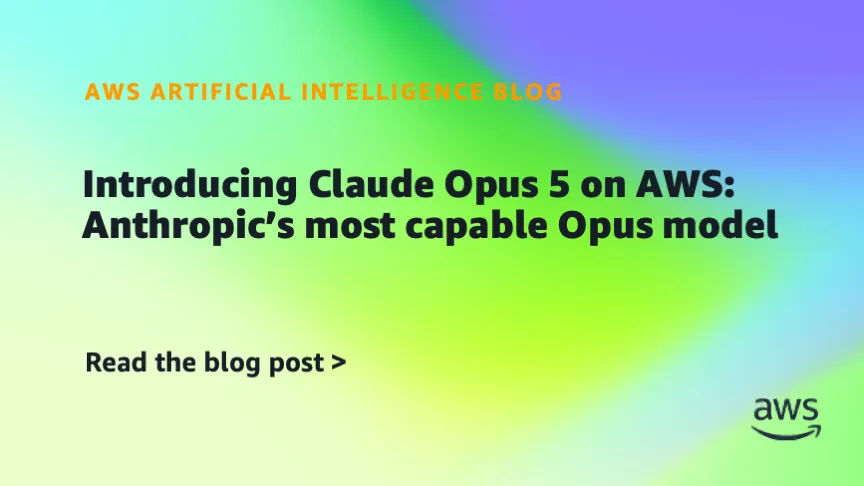
Claude Opus 5, Anthropic's fifth-generation Opus model, is now available on Amazon Bedrock and Claude Platform on AWS. The release targets AI builders and production teams who need frontier intelligence with enterprise-grade data governance, zero data retention (ZDR) by default on Bedrock, and tight AWS integration.
What happened
Anthropic launched Claude Opus 5 on Amazon Bedrock and Claude Platform on AWS, its most advanced Opus model and the first in the fifth generation. According to Anthropic, Opus 5 matches Claude Fable 5's top-tier intelligence in many domains at Opus-tier pricing.
On Amazon Bedrock, Claude Opus 5 benefits from zero data retention (ZDR) by default, meaning AWS does not retain customer data processed through the model. The model is powered by Bedrock's next-generation inference engine, letting teams build within their existing AWS environment, maintain enterprise security and regional data residency, and scale inference with zero operator access.
Claude Opus 5 is also available through Claude Platform on AWS, which supports zero data retention on request and gives access to Anthropic's native platform experience through the AWS Console with unified billing and authentication.
Availability spans multiple regions. On Bedrock, Opus 5 is available in US East (N. Virginia), Asia Pacific (Melbourne), Europe (Ireland), and Europe (Stockholm). On Claude Platform on AWS, it is available across North America, South America, Europe, and Asia Pacific.
Why AI builders should care
For teams shipping AI products on AWS, Claude Opus 5 reduces governance and deployment friction. The combination of ZDR by default, enterprise security, and scalable Bedrock inference means you can deploy a frontier model without negotiating separate data retention policies or managing cross-cloud infrastructure.
Anthropic says Opus 5 delivers a step-change in coding. It understands and navigates codebases like an experienced engineer and writes production-quality code while adapting its strategy as it works. It powers dependable long-running agents that work for hours or overnight, finding paths around obstacles, recovering from errors, and reaching their objectives.
For professional work, it brings deeper reasoning to long documents and higher accuracy to complex analysis, with the largest gains on document-heavy enterprise tasks. This matters for regulated industries like financial services, where Opus 5 handles compliance-sensitive work with more clarity and focus.
Practical implications
Developers can test Opus 5 immediately in the Bedrock console Playground and ship production inference workloads through Bedrock or Claude Platform on AWS.
Programmatic access is supported via multiple paths:
- AWS SDK for Python (Boto3) using bedrock-runtime
- Anthropic Messages API using the anthropic[bedrock] SDK package
- Amazon Bedrock Converse API for a unified multi-model experience
- AWS CLI and SDK for Invoke and Converse API calls
A notable developer feature: Opus 5 supports adding and removing tools mid-conversation through tooladdition and toolremoval content blocks on role: "system" messages, instead of re-sending the full top-level tools array. This simplifies agentic workflows where tool sets change dynamically.
For teams running multi-day projects, Opus 5 handles report building, auditing, document drafting, and structured analysis with high consistency. It also pushes back on flawed instructions and breaks complex jobs into sub-agents that need less oversight.
Caveats
Claude Opus 5 improves on Opus 4.8's cyber capabilities across the board, but in higher-risk areas, Opus 5 may fall back to Opus 4.8. Users are notified when this happens, and fallbacks can be configured when using the APIs.
Detailed performance metrics or long-term reliability claims beyond stated enhancements are not provided in the source material. Availability and regional support are subject to change. The model's pricing is described as Opus-tier, but specific per-token costs are not included in the AWS announcement.
For teams evaluating Opus 5 against other models, the key differentiator is not raw benchmark scores but the combination of frontier intelligence, zero data retention by default, and deep AWS integration for production inference workloads.
FAQs
Sources
- Introducing Claude Opus 5 on AWS: Anthropic’s most capable Opus model
- Claude Opus 5 is now available on AWS - AWS
- Introducing Claude Opus 5 \ Anthropic
- Models overview - Claude Platform Docs
- Anthropic's Claude models on AWS: What to know
- Anthropic release Claude Opus 5, its 'safest model yet'
- Anthropic upgrades Claude with new Opus 5 model, details here
- Anthropic Releases Claude Opus 5 to Be Your New 'Everyday' Assistant
- Anthropic unveils Claude Opus 5, says new model beats rivals on coding and business tasks
- Anthropic debuts Claude Opus 5 with top coding benchmarks at half the per-task cost
- Claude Opus 5: Release Date, What We Know & Model Guide | Coursiv Blog
- Anthropic launches Opus 5, closer and cheaper to frontier AI model Fable 5
- Anthropic's Opus 5 hauls Fable 5-level scores at half the price
- Anthropic launches Claude Opus 5 with efficiency, safety improvements
- Anthropic releases Opus 5 with ‘close’ to Fable 5’s capabilities