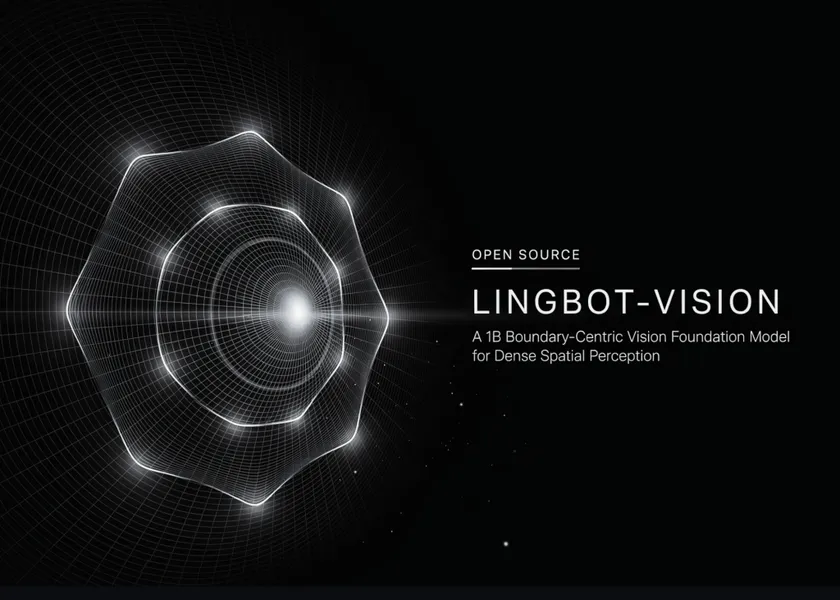
Ant Group's Robbyant open-sources LingBot-Vision, a boundary-centric vision model for embodied AI
Published by AINave Editorial • Reviewed by Ramit
Most vision foundation models learn what is in an image while discarding the fine-grained spatial structure that robots and other physically embodied systems depend on. LingBot-Vision inverts that priority: it treats object boundaries as a native pretraining signal rather than a downstream output. The result is a 1.1B-parameter backbone that matches or surpasses models up to 7x larger on dense spatial tasks, including the 7B DINOv3.
What happened
Robbyant, the embodied-AI company within Ant Group, open-sourced LingBot-Vision under Apache-2.0 on Hugging Face in four Vision Transformer sizes: ViT-giant (1.1B), ViT-large (300M), ViT-base (86M), and ViT-small. The release includes a technical report and inference code.
The flagship ViT-g/16 uses a novel masked boundary modeling objective trained on about 161M images curated from a 2B web pool. Importantly, the training corpus is an order of magnitude smaller than DINOv3's LVD-1689M, and the model consumes less than a third of DINOv3's training samples. No human labels, no external edge detectors, and no pretrained backbone to bootstrap from.
LingBot-Depth 2.0 extends the depth-completion system using LingBot-Vision initializations. The same masked-depth-modeling recipe from version 1.0 uses LingBot-Vision encoder initialization (ViT-L and ViT
Sources
- Ant Group’s Robbyant Open-Sources LingBot-Vision: A 1B Boundary-Centric Vision Foundation Model for Dense Spatial Perception
- GitHub - Robbyant/lingbot-vision: Self-supervised learning ...
- Ant Group's Robbyant Open-Sources LingBot-Vision 1B Boundary ...
- Technology - Robbyant
- Ant Group's Robbyant Open-Sources LingBot-Vision: How a 1B ...
- Robbyant · GitHub
- Robbyant Upgrades and Open-Sources LingBot-VLA 2.0 as a Next-Generation Universal Brain for Embodied AI
- Robbyant Unveils LingBot-Depth 2.0 and LingBot-Vision to Redefine Robotic Spatial Perception
- Glass crashes slashed? Ant Group embodied AI unit claims breakthrough in robot sensing
- Robbyant Open-Sources LingBot-VLA as a “Universal Brain” for Robots
- Ant Group 2025 Sustainability Report Highlights Record AI R&D Investment
- Robbyant Unveils LingBot-Depth 2.0 and LingBot-Vision to ...