Anduril's AI warfighting buildup: Seattle targets 1,000 engineers for edge AI hardware
Published by AINave Editorial • Reviewed by Ramit
Anduril is scaling its Seattle-area engineering hub to 1,000 people, building AI-driven hardware like EagleEye AR glasses and digital night vision systems that run on its Lattice software. For AI builders, this expansion shows how defense tech is integrating edge AI, real-time sensor fusion, and field-tested ML models into deployable warfighter systems.
Anduril's Seattle expansion targets 1,000 engineers
Anduril currently employs 560 people across its Bellevue and downtown Seattle offices, up from about 30 four years ago. Senior vice president Tom Keane told GeekWire the company could reach 1,000 engineers in the region over the next two years, with hiring constrained only by how fast it can find candidates. The company has more than 110 open positions in Washington state and recently leased a third floor in downtown Seattle.
The expansion is a direct play for engineering talent from Microsoft, Amazon, Google, and Meta. Keane noted that the region offers a rare concentration of distributed systems engineers, AI/ML specialists, and advanced optics experts. Anduril also absorbed about 100 local engineers 18 months ago when it took over Microsoft's IVAS (Integrated Visual Augmentation System) program for the U.S. Army.
EagleEye and digital night vision: AI at the edge
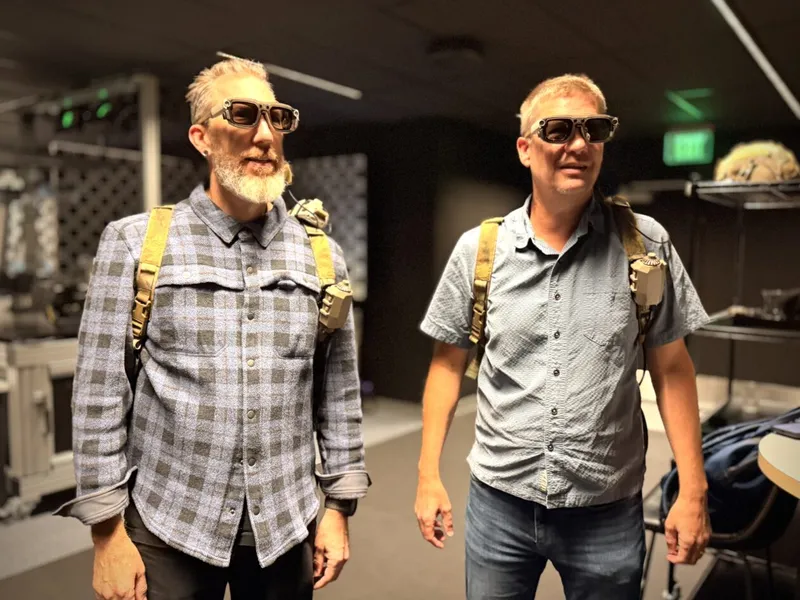
The centerpiece of Anduril's connected warfare division is EagleEye, a 115-gram augmented reality system built with Meta, Canon, Qualcomm, and Oakley. It replaces the 3-5 pounds of helmet-mounted gear soldiers currently carry, providing heads-up navigation, targeting, and intelligence feeds through Anduril's Lattice software.
Anduril also previewed a digital night vision system with an 84-degree field of view, more than double the 40 degrees of traditional analog goggles. Using machine learning models, the system fuses thermal imagery and low-light camera feeds in real time to highlight heat signatures. The night vision system has not yet been deployed but is slated for a Soldier Borne Mission Command prototype delivery to the U.S. Army next year.
Why this matters for AI builders
Anduril's approach demonstrates how hardware-enabled AI, edge computing, and mixed reality can be co-developed with field feedback from active-duty warfighters. The company operates a testing range in Carnation, Washington, where engineers iterate on code and hardware alongside soldiers from the 75th Ranger Regiment.
For AI builders, the key takeaway is the integration of real-time ML inference at the edge, lightweight wearable form factors, and a software platform (Lattice) that coordinates sensors, compute, and weapons. This is a model for building AI systems that must operate in disconnected, high-stakes environments.
Practical implications and caveats
Anduril's Seattle ramp-up is not without setbacks. The company vacated a Seattle shipyard after the Navy canceled an autonomous warship program, though it continues developing subsea systems like the Dive-XL. The digital night vision system is still in prototyping. Activist protests have occurred outside Anduril's offices, but the company says they do not affect hiring.
For builders considering defense tech, Anduril's trajectory shows that rapid scaling of AI hardware is possible when you combine deep pockets, a clear mission, and access to top engineering talent. But defense programs can shift, and timelines remain uncertain until systems are fielded.
FAQs
Sources
- Inside Anduril’s AI warfighting buildup: Defense giant sees a path to 1,000 Seattle-area engineers
- Anduril Industries — Википедия
- Inside Anduril’s AI warfighting buildup: Defense giant sees a path...
- Transforming U.S. Defense Capabilities with Advanced... | Anduril
- Inside Anduril’s AI war efforts: Palmer Luckey defends... | Cybernews
- Anduril Awarded $100 Million for AI Warfighting Platform | SOFREP
- Anduril exits Seattle shipyard following canceled Navy program and omission from new warship list
- Anduril Industries - Wikipedia
- Inside Anduril: Meet the quiet engineer-CEO building America's $31 billion weapons startup | Fortune
- Defense tech giant Anduril eyes new funding at $100B valuation as Seattle expansion draws protests – GeekWire
- How AI Is Changing Warfare with Brian Schimpf, CEO of Anduril | Andreessen Horowitz
- Autonomous weapons firm Anduril betting big on Seattle office, shipyard | APG State News | goskagit.com
- AI weapons under scrutiny as activists plan weekend protest at Anduril’s Seattle office
- Anduril CEO Brian Schimpf says AI and autonomous weapons will reshape modern warfare
- Anduril is building AI weapons to challenge America’s defence giants | Dagens.com