AI Scientist Runs Yeast Experiments, Then Learns From Results
Published by AINave Editorial
An AI system developed by researchers at Chalmers University of Technology did more than suggest biological experiments: it helped plan tests, direct laboratory automation and use the results to shape later hypotheses. In brewer’s yeast, that loop turned a failed prediction about glutamate into a test of aminoadipate, which improved growth under formic acid stress in the reported experiments. The study appeared in the Journal of the Royal Society Interface.
The system’s memory was structured, not just conversational
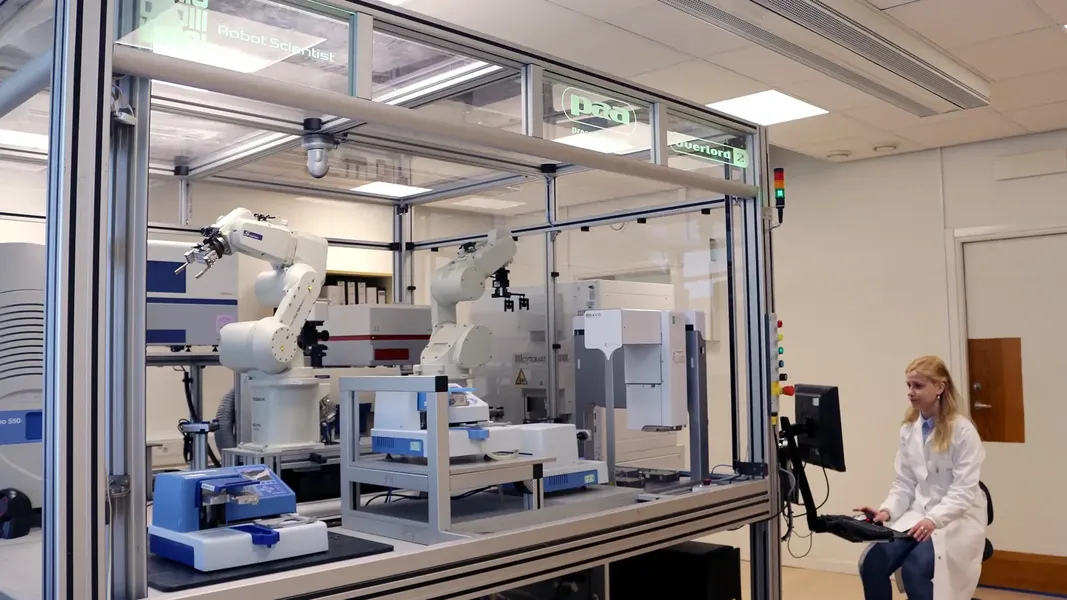
The team did not simply connect a chatbot to lab equipment. It assembled about 60,000 structured relationships about yeast physiology, metabolism and phenotypes. Inductive logic programming searched those relationships for patterns, generating 735 logic programs. Combined with metabolomics measurements, those programs yielded 1,933 candidate hypotheses involving 16 amino acids. An LLM then helped design interventions that fit laboratory constraints and translate them into instructions for automated equipment.
That division of labor matters. The system used explicit biological relationships and logic to narrow the space of questions, rather than relying on a language model alone to invent and validate claims. The study demonstrates a connected workflow, not an AI independently deciding which scientific problems deserve attention.
A failed prediction became a useful next step
Researchers selected hypotheses involving glutamate, arginine, proline, glutamine and lysine, and tested how the amino acids affected yeast exposed to chemical stresses. Robots handled liquid transfers, cultivation and sampling. The team measured growth over time and used ion-mobility mass spectrometry to assess metabolic profiles at the end of experiments. Some results diverged from predictions: arginine increased caffeine-related growth inhibition, while it did not rescue yeast from lithium stress as expected.
The more revealing sequence began with formic acid. The system first predicted that glutamate could protect the yeast, but the experiment did not support that mechanism. Researchers fed the new metabolomic data back into the pipeline; a regression model then ranked possible compounds and pointed to aminoadipate, an intermediate in lysine metabolism. In a follow-up, yeast growth improved by about 7% per millimolar increase in aminoadipate alongside formic acid. The researchers describe this as a first demonstration of aminoadipate conferring resistance to formic acid stress.
The useful capability here is not that every prediction was right. It is that a mismatch could change the next experiment instead of being discarded as a dead end. The result remains specific to the reported yeast experiments; it does not establish the same effect in other organisms.
Humans still set the boundaries
People defined the research scope and safety boundaries, supplied the system architecture and handled physical tasks such as moving plates between workstations and replenishing supplies. The experiments focused on relatively simple chemical and metabolic interactions in yeast, not autonomous selection of broad research priorities or interpretation of their wider significance. The researchers position the system as a way to automate parts of repetitive hypothesis testing while humans retain oversight and scientific judgment.
That makes the project a practical example of laboratory automation joined to iterative reasoning, rather than a replacement scientist. Its longer-term value will depend on whether the same approach can handle more complex biological questions while keeping experimental history usable and human oversight meaningful.