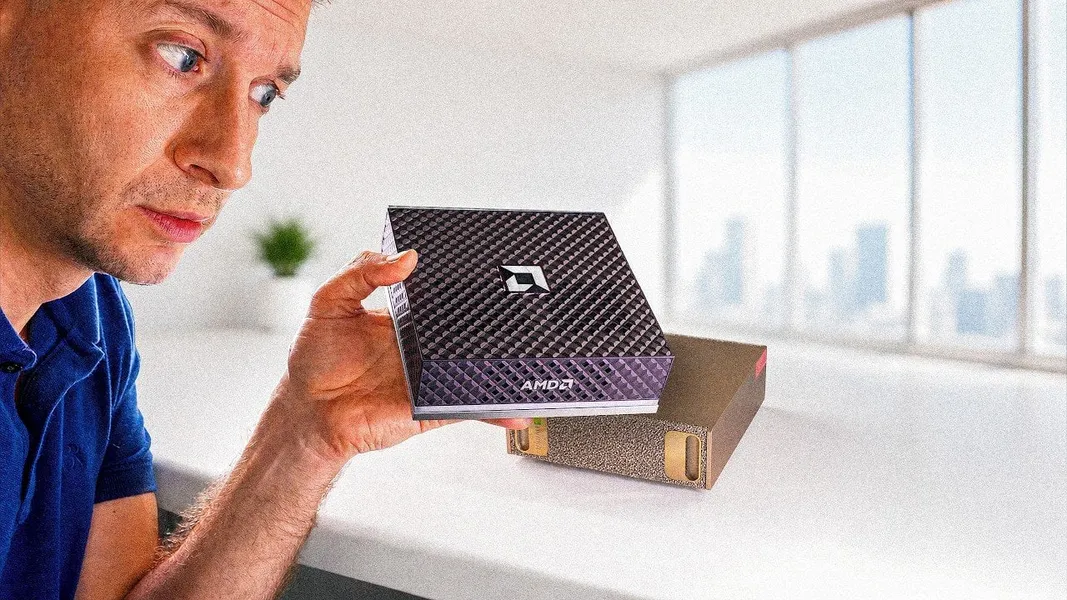
Ryzen AI Halo vs DGX Spark: A Tinkerer's Local AI Workstation Trade-Off
Published by AINave Editorial • Reviewed by Ramit
AMD's Ryzen AI Halo is a new $3,999 mini PC designed for local AI development, packing 128GB of unified memory and the Ryzen AI Max Plus 395 chip. It directly competes with NVIDIA's DGX Spark but focuses on accessibility, hybrid processing, and broad software compatibility rather than peak compute performance. For AI builders who want a ready-to-go local environment without cloud dependencies, the Halo presents a compelling trade-off.
What happened
AMD announced the Ryzen AI Halo as a compact developer platform powered by the Ryzen AI Max Plus 395 chip with 128 GB of unified memory. The system supports both Windows and Linux and ships with pre-installed tools including LM Studio, O Llama, and Comfy UI. Its x86 architecture ensures compatibility with a wide range of AI frameworks. Priced at $3,999, the Halo undercuts the DGX Spark by $700 and is available for preorder through Micro Center. AMD positions the Halo as a hybrid-processing alternative that prioritizes usability and energy efficiency over raw computational power.
Why AI builders should care
The Ryzen AI Halo targets individual developers, small teams, and AI enthusiasts who need a local AI environment without cloud dependencies. Its 128 GB unified memory and hybrid CPU/GPU/NPU design make it suitable for tasks like NLP token generation and local model testing. Compared to the DGX Spark, the Halo emphasizes practical flexibility and software compatibility rather than enterprise-grade compute. For builders who value a quick-start experience and broad framework support, the Halo reduces friction in setting up a local AI workstation.
Practical implications
At $3,999 with Windows or Linux out of the box, the Halo lowers the barrier to local AI experimentation. Its x86 compatibility means most existing AI frameworks and libraries run without porting effort. The pre-installed software suite lets developers start running models immediately. As noted by Windows Forum, a Strix Halo box can act as a coding workstation, a model testbed, a small inference server, and a general desktop. This versatility makes it a practical choice for teams that need one machine for development, testing, and light production inference.
Caveats
The Halo shows clear strengths in token generation but struggles with prefill (prompt processing) and compute-intensive tasks like large-scale image and video generation. AMD has planned software updates to improve performance, but long-term results remain unproven. Enterprise workloads that demand raw compute and scalability will likely still favor the DGX Spark. Builders should evaluate whether their primary use cases align with the Halo's hybrid processing strengths or if they need the DGX Spark's higher peak performance.
Sources
- Ryzen AI Halo vs NVIDIA DGX Spark: Which PC Wins for Local AI
- AMD challenges Nvidia's DGX Spark with $3,999 Ryzen AI Halo with Windows 11 support — Strix Halo desktop undercuts Nvidia by $700, packs 128GB of unified memory | Tom's Hardware
- AMD Ryzen AI Halo vs NVIDIA DGX Spark Local AI Workstations
- AMD Ryzen AI Halo vs NVIDIA DGX Spark 2026: Which 128GB AI Dev Kit Actually Pays Off
- AMD Ryzen AI Max+ 395 mini PC: 128GB local AI workstation vs DGX Spark | Windows Forum
- AMD tops $900B market cap for first time as Ryzen AI Halo challenges Nvidia DGX Spark
- AMD challenges Nvidia's DGX Spark with $3,999 Ryzen AI Halo with Windows 11 support
- AMD's Ryzen AI Halo AI mini PC launches in the US with 128GB memory and a $3,999 price tag
- AMD Ryzen AI Halo Dev Kits Hit Retail With 128GB RAM And $3,999 Price Tag
- AMD Ryzen AI Halo First Look: Giant Local AI Power in a Pint-Sized Box
- DGX Spark vs Strix Halo — 128GB AI Desktop 2026
- AMD Ryzen AI Halo vs. Nvidia DGX Spark: Which $4,000 AI Mini ...
- AMD's tiny Ryzen AI box does what Nvidia's DGX Spark does at ...
- AMD prices its Ryzen AI Halo PC at $3,999, unveils Ryzen AI Max 400 chips
- I clustered two Nvidia DGX Spark AI boxes in my living room. Here's what happened