Claude Reflect: Anthropic ships a beta usage dashboard to help users audit and rethink their AI work
Published by AINave Editorial • Reviewed by Ramit
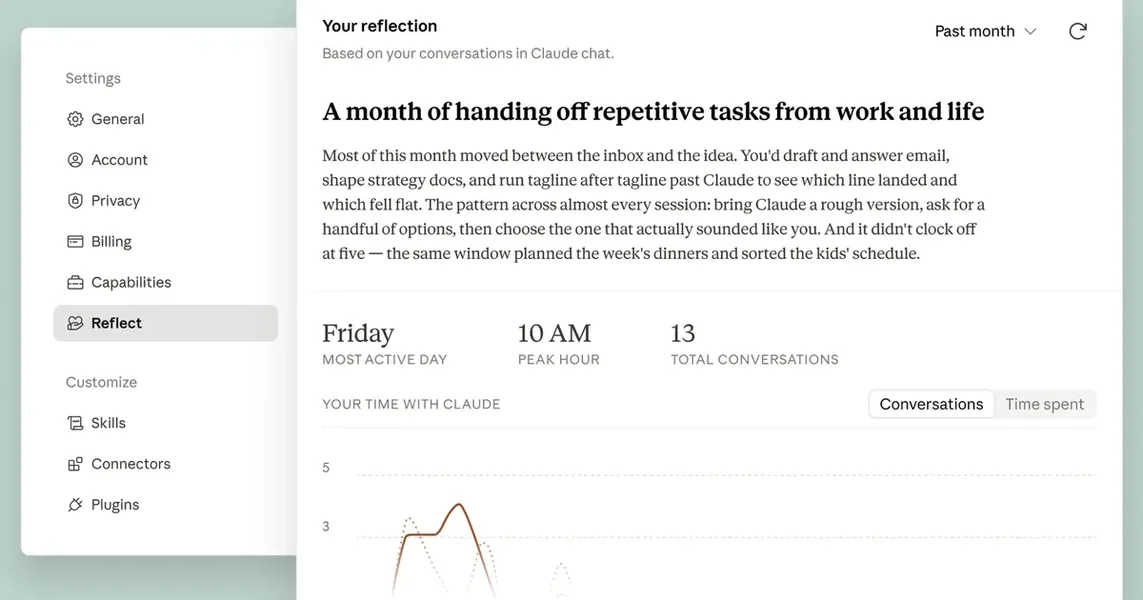
Anthropic has released Claude Reflect, a usage analytics dashboard for Claude that helps users audit their AI interactions and rethink how they rely on the chatbot. Available in beta for Free, Pro, and Max users with memory enabled, Reflect generates summaries of activity over 1, 3, 6, or 12 months, breaks down topics, and classifies interactions using Anthropic's 4D AI Fluency Framework. The feature also includes quiet hours, break nudges, and AI fluency recommendations to encourage more mindful use.
What happened
Claude Reflect is accessible through the Settings menu in Claude's web and desktop apps. By default it shows the last month of activity, but users can select 3, 6, or 12 month views. The dashboard displays the most active day, peak hour, and total chats alongside a visual activity graph. A time-spent metric is planned but not yet shown.
Interactions are categorized using the 4D AI Fluency Framework: delegation, description, discernment, and diligence. The dashboard also offers AI fluency recommendations, such as using the Projects feature to group prompts or creating a custom fact-checking template that lists sources and confidence levels.
Anthropic clarified that incognito and health-integration conversations are excluded from Reflect. Data remains in the dashboard and is not used for other purposes. The feature was developed with MIT Media Lab, the Digital Wellness Lab at Boston Children’s Hospital, and the Family Online Safety Institute.
Why AI builders should care
Claude Reflect is a case study in embedding usage analytics and wellbeing prompts directly into an AI product. According to Ryn Linthicum, Anthropic's head of wellbeing policy, the goal is to upskill usage and reduce uneconomical reliance on Claude, not to maximize time spent. This approach signals a shift from pure engagement metrics toward user efficiency and mindful use.
For teams building AI tools, Reflect demonstrates how analytics can drive behavior change. The dashboard surfaces questions like "What's one thing you want to keep doing yourself, even if Claude could do it faster?" and allows users to set quiet hours and break reminders. These patterns could be replicated in other AI products to help users audit their workflows and avoid over-reliance.
The broader context matters too. Deloitte's 2026 Back-to-School Survey of 1,207 parents found that 49% worry their child relies on AI too much, highlighting demand for usage accountability features in consumer AI.
Practical implications
For product teams, Reflect shows how to turn raw conversation history into behavior analytics. The dashboard provides a structured breakdown of how users work with AI, not just raw counts. This can help users audit their own patterns and identify tasks better done without AI.
The privacy design offers a template: exclude sensitive conversations, keep data local to the dashboard, and avoid using it for model training. However, the exclusion of incognito chats means power users who value privacy may see incomplete reports. The planned time-spent view will add another layer of transparency, but it is not yet available.
AI fluency recommendations are a practical addition. For example, if a user frequently re-establishes context, Reflect suggests using the Projects feature to group prompts. This kind of contextual guidance can reduce friction and improve efficiency without requiring users to discover features on their own.
Caveats
Claude Reflect is in beta, and details may evolve as the feature matures. The time-spent metric is not yet visible, and future updates may change what is tracked. The dashboard is currently limited to web and desktop apps; mobile support is planned but not yet available.
Broader privacy and surveillance discussions around AI usage analytics remain relevant. While Anthropic has designed Reflect with exclusions and data isolation, the feature still collects detailed interaction data that could raise concerns in enterprise or regulated environments. Teams should evaluate whether similar analytics in their own products align with user expectations and compliance requirements.
FAQs
Sources
- Claude Reflect is here. It’s your usual yearly Wrapped, but with Anthropic’s AI
- Claude's new Reflect dashboard wants to help you log off of Claude
- Claude will now let you 'reflect' on how much you're using Claude
- Claude Reflect is here. It’s your usual yearly Wrapped, but ...
- Claude Reflect wants to get insightful with your AI usage ...
- A new way to reflect on how you use Claude \ Anthropic
- Say hello to Claude Wrapped - The Verge
- Claude Just Got Its Own 'Spotify Wrapped.' Here's What It Reveals About How You Use AI
- Claude's New Reflect Dashboard Wants To Help You Log Off Of Claude
- Anthropic's new Claude feature is quietly selling you on AI
- Anthropic’s new Claude feature is quietly selling you on AI
- Anthropic launches Claude reflection dashboard for usage ...
- Claude
- Secret Claude tracker shocks users after Anthropic’s anti-surveillance stance
- Anthropic Is Bringing Together AI Design and Coding in Claude
- Anthropic Walks Back Policy That Could Have ‘Sabotaged’ AI Researchers Using Claude
- Anthropic releases Mythos-like AI model to the public two months after private rollout rocked Wall Street