NASA's Gemma 3 Goes Orbital: First In-Space Vision-Language Model Demo
Published by AINave Editorial • Reviewed by Ramit
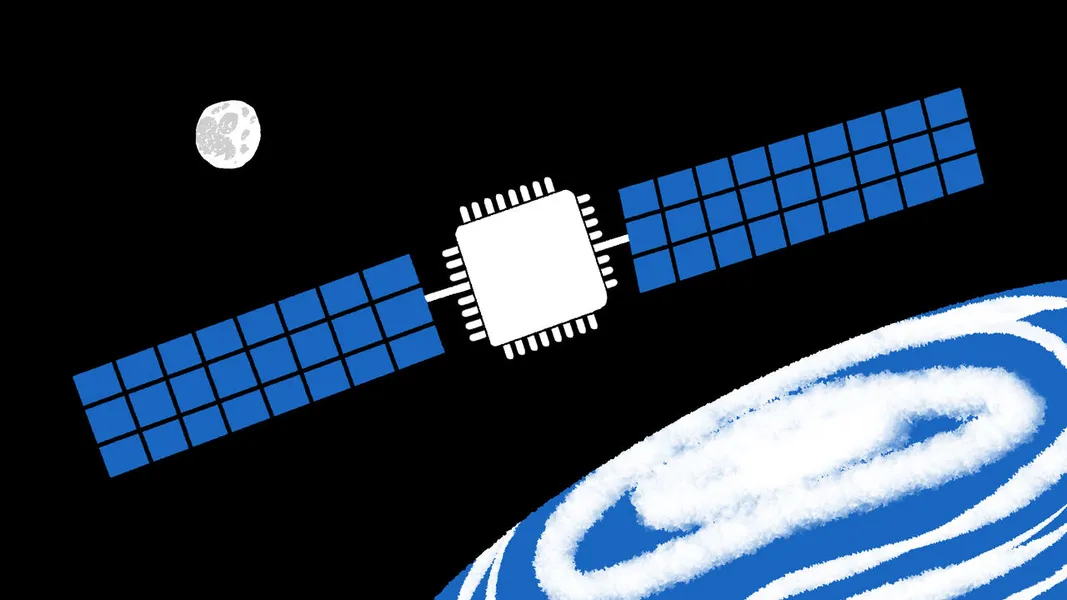
NASA's Jet Propulsion Laboratory demonstrated the first in-orbit use of a vision-language model by running Google's Gemma 3 (4-bit, 4B parameter configuration) on a satellite. The system, called NAVI-Orbital, analyzed images captured by Loft Orbital's YAM-9 satellite and produced onboard text descriptions, answering scripted questions about the imagery. This marks a shift in how spacecraft can be interacted with, replacing rigid command sequences with natural language prompts.
What happened
NAVI-Orbital ran a compressed 4-bit version of Google Gemma 3 on an Nvidia Jetson Orin AGX module, which requires only 8GB of memory. The satellite carries a compute cluster of radiation-hardened processors (FPGAs, CPUs, GPUs) powered by solar panels delivering 150 to 500 watts. Two live in-orbit tests were performed: one over Toulouse, France, and one over the coast of Argentina. In each test, the satellite captured an image and the model generated a plain-text description along with answers to predefined questions about commercial areas, residential zones, and natural features.
Before launch, the system achieved 88% accuracy on a ground benchmark of 7,960 images without any fine-tuning on that dataset. The model used is the same base Gemma 3 available from Hugging Face.
Why AI builders should care
This demonstration proves that lightweight vision-language models can run on space-grade hardware with tight power and bandwidth constraints. The key implication is semantic compression: instead of downlinking large raw image files, a satellite can transmit a short text summary. For time-sensitive applications like wildfire detection, this could cut delays from up to 90 minutes to near real-time. Paul Lasserre, general manager at Loft Orbital, called this a paradigm shift for orbital operations, noting that slow data links become less limiting when only dozens of kilobytes need to be transmitted.
For builders of edge AI products, the NAVI-Orbital approach shows that prompt-driven image analysis can be deployed on embedded hardware without custom training or model swaps. Retargeting the system for a new observation task is as simple as editing a text prompt.
Practical implications
The architecture is deliberately sandboxed: NAVI-Orbital reads images and produces descriptions but has no access to flight control software. This safety boundary allows operators to experiment with onboard AI without risking the spacecraft. The LangGraph-based conductor coordinates workflows, making the system modular and extensible.
Longer term, the JPL team envisions this technology as a natural language assistant for astronauts, helping with tasks inside and outside spacecraft without requiring structured commands or dedicated operations teams.
Caveats
The live tests were controlled demonstrations, not long-term operational deployments. Reliability in harsh space radiation and thermal conditions over extended periods has not been proven. The model runs in a 4-bit 4B configuration with 8GB memory, which limits the complexity of tasks it can handle. Scaled-up models or broader capabilities would require more power and radiation-hardened compute that may not yet be available in orbit. Additionally, the 88% accuracy benchmark was conducted on the ground; in-orbit accuracy was not independently verified with a large test set.
FAQs
Sources
- NASA Puts Google’s Gemma Large Language Model in Orbit
- Satellite Autonomously Detects Target Using Vision Language Model...
- First AI Model in Orbit: Google Gemma 3 on Loft Orbital's YAM-9
- AI Space Race: Tech Giants' Orbital Bet | Fares Solution
- Starcloud Successfully Operates First AI Model in... | MEXC News
- Gemma 4 — Google DeepMind
- NASA puts Google’s Gemma large language model in orbit
- Gemma — Google DeepMind
- Welcome Gemma 4: Frontier multimodal intelligence on device
- Running Gemma 4 Locally: Ollama, llama.cpp, MLX... - PyImageSearch
- NASA puts Google’s Gemma large language model in orbit - MSN
- Loft Orbital's Yam-9 Runs Google DeepMind's Gemma 3 Directly ...
- Satellite AI Inference Clears Orbit: Gemma 3 Ran Aboard YAM-9 ...
- NAVI-Orbital: AI Agents and Edge Computing in Space — The ...
- Loft Orbital's Yam-9 runs first vision-language model in orbit