LG and NVIDIA team up to put AI brains in humanoid robots, with early 2027 reveal and factory ambitions
Published by AINave Editorial • Reviewed by Ramit
LG is entering the humanoid robot race with NVIDIA providing the AI stack. The company plans to reveal a bipedal humanoid in early 2027, powered by NVIDIA's Jetson Thor chip for reasoning and the Isaac GR00T foundation model for processing, with the Halos safety framework onboard. For AI builders, this signals a shift toward integrated hardware-software platforms for physical AI, with LG also building AI factories and a robot data factory that could become infrastructure for training and deployment.
The humanoid robot: specs and timeline
LG and NVIDIA signed a memorandum of understanding at NVIDIA's Santa Clara headquarters, with LG Chairman Kwang Mo Koo and NVIDIA CEO Jensen Huang present. The centerpiece is a bipedal humanoid robot LG plans to publicly reveal in early 2027, timed for CES 2027. The robot runs on NVIDIA's Jetson Thor chip, which handles reasoning, and the Isaac GR00T foundation model for processing. NVIDIA's Halos safety framework, described as the industry's first full-stack safety framework built for robots, is also onboard. LG is sourcing actuators, sensors, and batteries from its own Electronics, Innotek, and Energy Solution divisions, which should simplify supply chain management.
Why the robot data factory matters for training
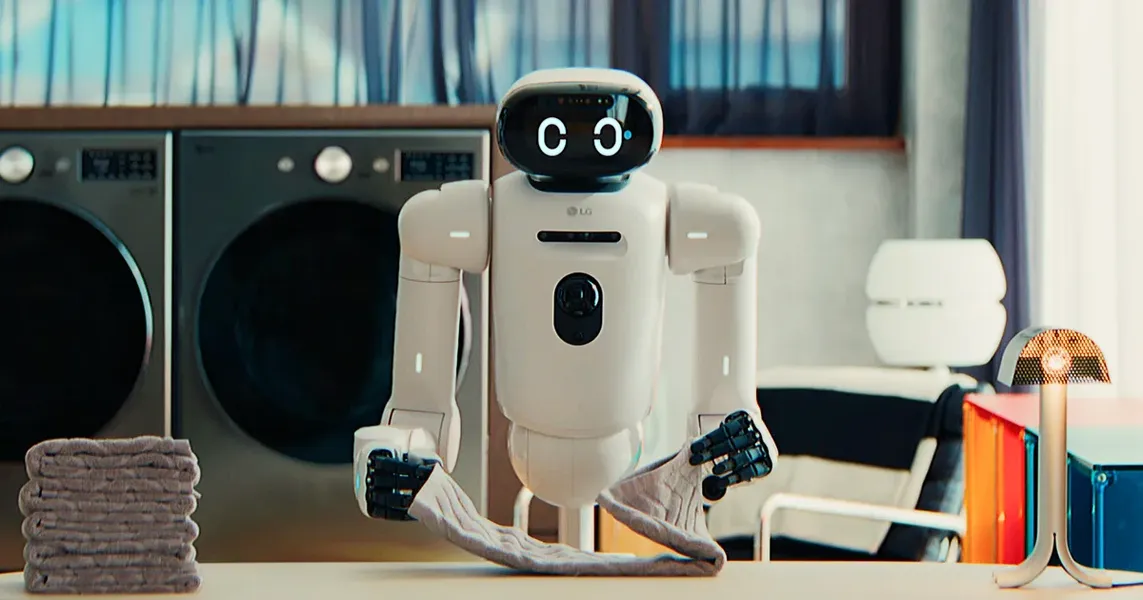
LG isn't waiting until 2027 to start real-world testing. This year, the company is deploying its wheel-based robot, LG CLOiD, as a factory trial. To feed the machines training data, the partnership includes building a "robot data factory" powered by LG CNS's PhysicalWorks platform. For builders, this is a notable approach: using a deployed robot to generate real-world interaction data that can then be used to train the humanoid. If successful, it could accelerate the training loop for physical AI without relying solely on simulation.
AI factories as infrastructure play
Beyond robots, LG is building two AI factories. An AI factory reference site on NVIDIA's Vera Rubin platform is planned by mid-2027, followed by an 80-megawatt LG AI Factory in Cheonan, South Korea by mid-2028. These facilities are designed to support AI workloads, and the reference site could serve as a blueprint for other companies looking to deploy NVIDIA's next-generation hardware. For AI builders, this means more compute capacity for training and inference, though the timeline is two to three years out.
What's still unclear
The announcement is based on a single source, and many details remain thin. The exact capabilities of the humanoid robot, its intended use cases, and pricing are not disclosed. The Halos safety framework is billed as a full-stack solution, but it has not been proven at scale in human-occupied environments. The CLOiD trial this year will be an important test of LG's data collection pipeline. Additionally, the robot's reliance on NVIDIA's stack means LG is deeply tied to NVIDIA's roadmap, which could be a risk if hardware or software priorities shift. Builders should watch for more concrete technical specifications and independent safety evaluations before making decisions based on this roadmap.