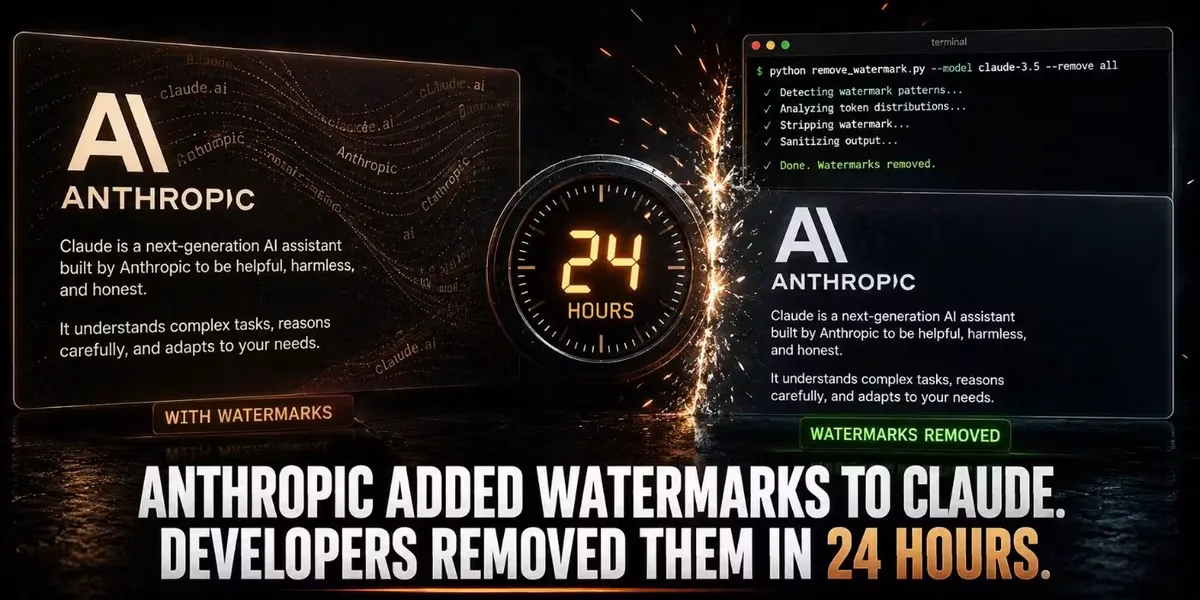
Claude's Invisible Watermark Sparks an AI Provenance Arms Race: What Builders Need to Know
Published by AINave Editorial • Reviewed by Ramit
Anthropic's Claude models released on or after August 2, 2026 now embed invisible watermarks in every piece of generated text and attach C2PA provenance metadata to files. Within 24 hours of the announcement, developer Guillaume Meyer released an open-source tool to remove them, quickly gaining thousands of GitHub stars. For AI builders, this creates a new reality: your outputs carry a persistent provenance signal, but that signal can be partially disrupted, and no public detector exists yet to verify it.
Two watermarks, one announcement
Anthropic's watermarking has two distinct layers. The first is C2PA provenance metadata attached to generated files (PNG, JPEG, SVG, PDF, DOCX, HTML, MD). This is an open industry standard that embeds a digitally signed certificate saying the file was created by Claude. The second is a statistical sampling watermark woven into the text itself. The model biases its token choices according to a secret pattern, creating a detectable statistical signal across longer outputs. Both layers apply globally across Claude.ai, the Claude API, Claude Code, and partner platforms like AWS Bedrock, with no opt-out.
The metadata layer: easy to strip
The C2PA metadata layer is trivially removable. Standard tools like exiftool have been stripping file metadata for decades. The watermarks-remover tool handles this layer effectively, and the developer has verified it works. For builders, this means any file-based provenance signal is only as strong as the user's willingness to preserve it.
The text watermark: harder to remove, harder to verify
The statistical text watermark is the more interesting and contested layer. It is not a hidden character or metadata field; it is woven into the word choices themselves. To disrupt the signal, you need to rewrite enough of the text to break the statistical pattern. The watermarks-remover tool attempts this by rephrasing content, but its own README honestly states: "Until vendors ship public detectors and keys, no tool can honestly certify 'this fails the official check.'" Anthropic has not released a public detector, so there is no way to verify whether any bypass tool actually defeats the watermark. This is the core uncertainty for builders.
Why this matters for AI builders
If you build products on top of Claude, your users' content now carries a persistent provenance signal. This affects trust, compliance, and user privacy expectations. The watermark signals that Claude processed the text, not that Claude authored it. If a user edits heavily, the text still carries the mark. The practical risk is not perfect detection but an awkward conversation when a future detector flags content as AI-generated, even when the work was substantially human. You cannot opt out at the API level, so you need to decide whether to disclose this to your users and how it affects your product's value proposition.
The regulatory driver: EU AI Act
Anthropic's move is driven partly by the EU AI Act, which requires watermarking for high-risk AI systems. Noncompliance can trigger penalties up to 15 million euros or 3% of global revenue. The regulation applies at the model level, meaning the watermark is baked into every Claude output regardless of deployment. This legal pressure ensures the watermark will persist even if bypass tools proliferate, creating a long-term compliance requirement for any platform distributing Claude-generated content in regulated markets.
Caveats and what remains unclear
The most important caveat is the missing public detector. Without it, no one can independently verify whether a given text carries the watermark or whether a bypass tool actually removed it. The arms race is real: metadata stripping works, text rewriting is unverifiable, and paid services like StealthGPT have already added "Claude watermark bypass" to their feature lists. But the population-level transparency goal remains intact. If 95% of Claude outputs retain the watermark, researchers and regulators can still measure AI content flow even if a motivated minority strips it. For builders, the takeaway is to understand both the signal and its limits, and to plan for a future where provenance verification becomes a standard part of AI product design.
FAQs
Sources
- It Took Developers 24 Hours to Build Around Claude's Invisible Watermark | HackerNoon
- Claude
- Claude Previous Response Still Running: Fix It Fast
- Newsroom \ Anthropic
- SynthID — Google DeepMind
- I Built an AI App in 4 Days — here’s how I did it | by Shaw Talebi
- Coders Say They Already Found Workarounds to Claude’s Invisible Watermarks
- Claude's Watermark Proves It Was Used, Not Who Wrote It
- Introducing the next generation of Claude \ Anthropic
- hackernoon.com/n2ws-rebrand-empowering-it-teams-to-ditch-the-drama
- Claude Code by Anthropic | AI Coding Agent, Terminal, IDE
- Online Python - IDE, Editor, Compiler, Interpreter
- Challenge Your Game | FACEIT