Archipelo’s Salmon Adds Verifiable Execution History for AI Agents
Published by AINave Editorial • Reviewed by Ramit
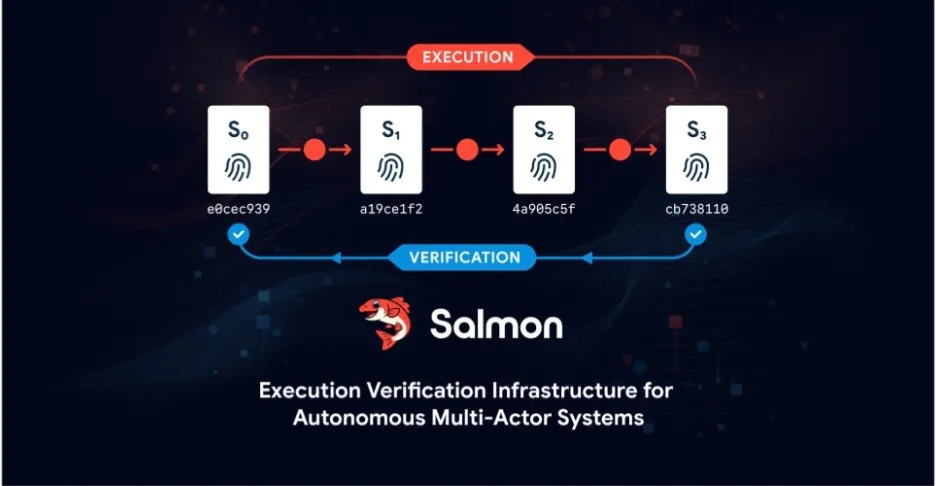
Archipelo announced Salmon on September 25, 2026, describing it as Execution Verification Infrastructure (EVI) for AI agents and autonomous systems. Its aim is to preserve verifiable evidence of what executed and what changed, a history that may not be recoverable from a system’s current state alone, according to the company announcement.
That distinction matters when software acts across tools, credentials, APIs, and infrastructure. A final state can show that something changed; Salmon is designed to record the sequence of events that led there. Archipelo links the launch to an incident involving OpenAI and Hugging Face, but the details in its announcement are an account of what OpenAI reported, not independent verification of the incident.
What Salmon’s execution record is designed to capture
Archipelo says Salmon records execution as signed events, with each event identifying the actor, the action, the state before and after, and a cryptographic signature. It links these events into a Verifiable Execution Record, intended to preserve the lineage between an action and the state it produces (announcement details).
The practical idea is to give other systems structured evidence they can use for investigation, detection and response, remediation, supervision, or accountability. Salmon is meant to establish the record; downstream systems then reason from it. The announcement also says that when execution evidence is unavailable, Salmon preserves that gap instead of filling in a continuous history. That is an important design distinction: a visible gap is more informative than a record that implies completeness without evidence.
Evidence complements permissions and monitoring
The announcement separates execution verification from several neighboring security functions. Identity establishes who or what is acting; authorization sets what that actor may do; runtime controls govern whether execution should proceed; and observability monitors behavior. Execution verification asks what actually executed, and whether its history can be independently verified (Archipelo’s description of these roles).
These functions answer different questions, so an execution record should not be mistaken for an access-control system. A record of an action does not, by itself, prevent an unauthorized action. Archipelo presents Salmon as an evidence layer for autonomous systems, not as a replacement for identity, authorization, runtime controls, or monitoring.
The supplied announcement is a product description, not an independent evaluation. It does not provide implementation detail or testing that would let readers assess how records are verified in practice or establish that Salmon prevents unsafe behavior. The useful promise is narrower: make actions and their resulting state changes easier for other systems to inspect as a linked history. Whether that evidence is complete and dependable in deployment is central to the product’s value.