AMD Zen 6 Venice EPYC: 256-core data-center CPU signals architectural gains beyond cores
Published by AINave Editorial • Reviewed by Ramit
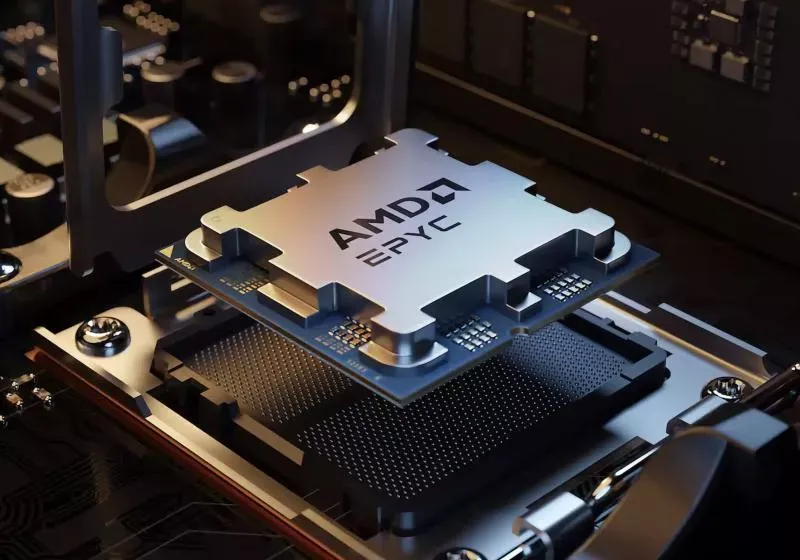
AMD is giving its first public look at the Zen 6-based EPYC Venice CPU at the Advancing AI 2026 summit on July 22. The chip packs up to 256 cores, built on TSMC's 2-nanometer process, and introduces a new SP7 socket with 16-channel memory delivering up to 1.6 TB/s bandwidth. For AI builders, the architectural changes matter more than the core count increase alone.
What happened
AMD will showcase the EPYC Venice (6th-gen EPYC 9006 series) at the Advancing AI 2026 summit in San Francisco. The chip increases core count from 192 to 256, but AMD claims a major speed increase that suggests architectural improvements beyond just more cores. Venice is built on TSMC's 2nm process, a node shift that brings both performance and efficiency gains.
The platform introduces a new SP7 socket and supports 16-channel memory, providing up to 1.6 TB/s of memory bandwidth. Venice also supports PCIe 6 for CPU-to-GPU communication and is designed to pair with AMD's Instinct MI455X GPUs in Helios rack systems. This setup targets better CPU-GPU cooperation for AI training and inference workloads.
On the consumer side, Zen 6 desktop chips (Ryzen) were initially expected in 2026, but memory shortages have pushed the rumored launch to early 2027. AMD's lack of Zen 6 announcements at Computex reinforced that delay.
Why AI builders should care
For teams building AI infrastructure, Venice represents a shift in how CPU performance scales for AI workloads. The combination of 256 cores, high memory bandwidth, and PCIe 6 means the CPU can feed data to GPUs faster and handle larger in-memory datasets. This is relevant for preprocessing pipelines, real-time inference serving, and large-scale model training where CPU bottlenecks often limit GPU utilization.
The 16-channel memory and 1.6 TB/s bandwidth are designed for compute-heavy AI tasks. If you are architecting a training cluster or an inference farm, Venice could reduce the number of CPU sockets needed per rack while maintaining or improving throughput.
Practical implications
For builders evaluating hardware for AI workloads, here is what changes:
- Higher core density per socket: 256 cores means more parallel processing for data loading, tokenization, and embedding generation without moving to multi-socket configurations.
- Faster CPU-GPU interconnect: PCIe 6 doubles the bandwidth of PCIe 5, reducing data transfer latency between CPU memory and GPU accelerators. This matters for models that require frequent CPU-GPU communication, such as mixture-of-experts or retrieval-augmented generation pipelines.
- New platform investment: The SP7 socket and 16-channel memory require new motherboards and memory configurations. Existing EPYC Turin (Zen 5) infrastructure will not be compatible.
- Consumer Zen 6 delayed: If you are building on-premise workstations or edge servers with Ryzen, expect Zen 6 desktop parts no earlier than early 2027.
Caveats
All performance claims are based on AMD's pre-launch estimates and press coverage. The 1.7x performance improvement figure comes from AMD's own materials and has not been independently verified. Real-world AI workload performance will depend on specific model architectures, software optimizations, and system configurations. Pricing, availability, and exact model SKUs have not been announced. The consumer Zen 6 timeline is based on industry rumors and may shift again.
FAQs
Sources
- AMD's Zen 6 Epyc chip packs 256 cores, promises up to 1.7x faster AI
- AMD 6th Gen EPYC 9006 Venice CPUs reportedly offer up to 96 Zen 6 or ...
- AMD fires back at Nvidia, claiming 256-core Zen 6 'Venice' CPU beats ...
- AMD's next-gen Zen 6 EPYC Venice CPU: over 70% more ... - TweakTown
- AMD Confirms Next-Gen EPYC Venice "Zen 6" CPUs With 256 Cores In 2026 ...
- AMD begins production ramp of 256-core EPYC Venice — first 2nm HPC chip claims 70% performance leap
- AMD claims 256-core Zen 6 'Venice' CPU beats Nvidia Vera by 3.3x in rack-level performance
- AMD claims next-gen Zen 6 server CPU will deliver 330% of Nvidia Vera's performance per rack
- AMD's Zen 6 will introduce a new low-power, compact core for better battery life
- Zen 6 - Wikipedia
- AMD confirms Zen 6 launches in less than two weeks, starting with EPYC Venice - VideoCardz.com
- AMD Zen 6 EPYC "Venice" Introduces a Radical Package Redesign | TechPowerUp
- AMD claims 256-core Zen 6 'Venice' CPU beats Nvidia Vera by 3.3x in rack-level performance
- AMD: EPYC, Not Instinct, Is Leading AI Growth - Hold
- AMD's Zen 6 Desktop Chips May Trade Integrated Graphics For AI NPUs