AI-assisted police reporting: Michigan pilots reveal mixed results and design challenges for builders
Published by AINave Editorial • Reviewed by Ramit
Michigan police departments in Dearborn Heights and Warren are piloting Axon Draft One, an AI tool that generates police reports from body camera transcripts. The promise: cut the hours officers spend writing narratives and get them back on the street. The reality, based on early University of South Carolina studies and prosecutor feedback, is more complicated. Builders evaluating this space should note that time savings are inconsistent, accuracy suffers, and deployment requires safeguards that go well beyond the model itself.
How Draft One generates police reports from body camera audio
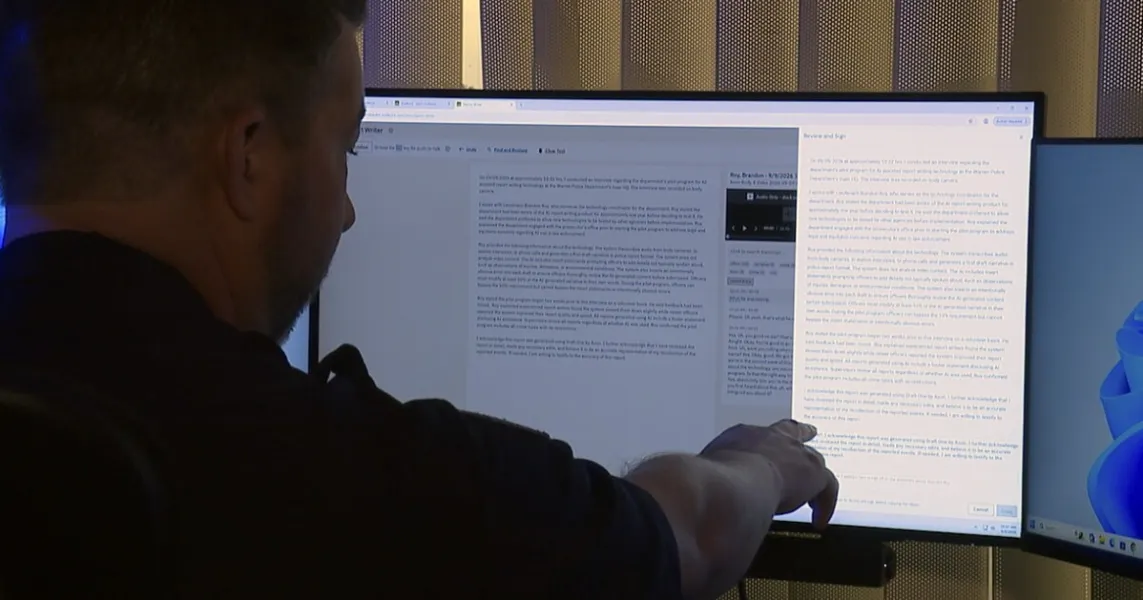
Draft One works by transcribing conversations recorded on body cameras and feeding those transcripts into an AI model that produces a narrative summary. Officers then edit the draft, add information, and must ultimately attest that the report represents their perspective. Dearborn Heights adopted the tool early with voluntary use, while Warren launched a 60-day pilot where officers are required to write only 10% of each report's narrative themselves. Some agencies, like the Kent County Sheriff's Office, limit AI use to non-violent offenses. (Source: Scripps News)
Why early results should give builders pause
A University of South Carolina study led by Ian Adams found that Draft One did not actually save officers time overall, because they still had to verify and correct the output. A second USC study compared AI-assisted reports to officer-written ones and found the AI versions were rated "substantively and significantly lower on accuracy," even though they used higher-grade vocabulary. Wayne County Prosecutor Kym Worthy warned departments "to be cautious and restrained," calling AI report writing "an area fraught with problems" that could jeopardize cases. (Source: Scripps News)
Outside Michigan, the reaction is even more cautious. Prosecutors in King County (WA) will not accept AI-written reports, and Connecticut has paused their use entirely over accuracy concerns. This fragmented policy landscape means any AI-assisted reporting tool must prove it can produce court-admissible narratives.
What builders can learn from Michigan's pilot safeguards
Axon has designed several specific safeguards worth understanding. Draft One inserts deliberate errors, known internally as "Easter eggs," that officers must find and delete. In the demonstration seen by Scripps News, the error read: "the primary suspect was absolved by presenting a convincing alibi involving a time loop." This forces human review. The Macomb County prosecutor's office also recommends clear labeling, meaningful officer editing, and supervisory approval. (Source: Scripps News)
For builders, these examples point to design requirements: adversarial testing built into the workflow, explicit audit trails, and mandatory human verification steps. The tool cannot be a black box. The officer must own the report and be able to testify from memory, not just from the AI output, as Southfield Police Chief Elvin Barren emphasized.
Where the evidence falls short and what remains uncertain
The current evidence comes from small pilots and university studies. Only one agency (Fort Collins, CO) has reported a 67% reduction in report-writing time, but that claim comes from a vendor spokesperson and is not reflected in the Michigan pilots. Warren's commissioner described the first three weeks as "mixed," with skilled writers seeing little benefit and weaker writers benefiting more. No independent studies have examined long-term effects on court outcomes or officer skill atrophy. Builders should treat reported time savings as situational and likely contingent on officer skill and report complexity.
Prosecutor policies are still being written. Wayne County is crafting a countywide policy expected in weeks. California SB 524 now requires disclosure of AI use in reports. The deployment environment for AI-assisted police reporting remains in flux, and any product entering this space must be prepared for rapid policy evolution across jurisdictions.
FAQs
Sources
- Police departments are turning to AI for help writing up their reports
- Police departments are turning to AI for help writing up their reports
- More Minnesota Police Departments Turning To AI For Report...
- Police departments turn to ‘Grappler’ device to stop pursuits before...
- Log in to your Grammarly and start writing something amazing.
- Trail camera captures promising signs of an expanding Florida panther...
- How AI is being used by police departments to help draft reports
- Idaho police use AI to write reports from body camera footage. Is it a good...
- Can AI help Fresno police do their jobs? Why it could be good and why many are...
- Concerns about AI-written police reports spur states to regulate the emerging...
- Portage officers adopt AI writing tool amid larger move to tech
- Police departments are turning to AI for help writing up their reports
- Using AI to Write Police Reports - cops.usdoj.gov
- Police Departments Are Now Using AI to Write Reports
- What Happens When Police Use AI to Write Arrest Reports?
- Automated report writing: Benefits and risks for police