Overview
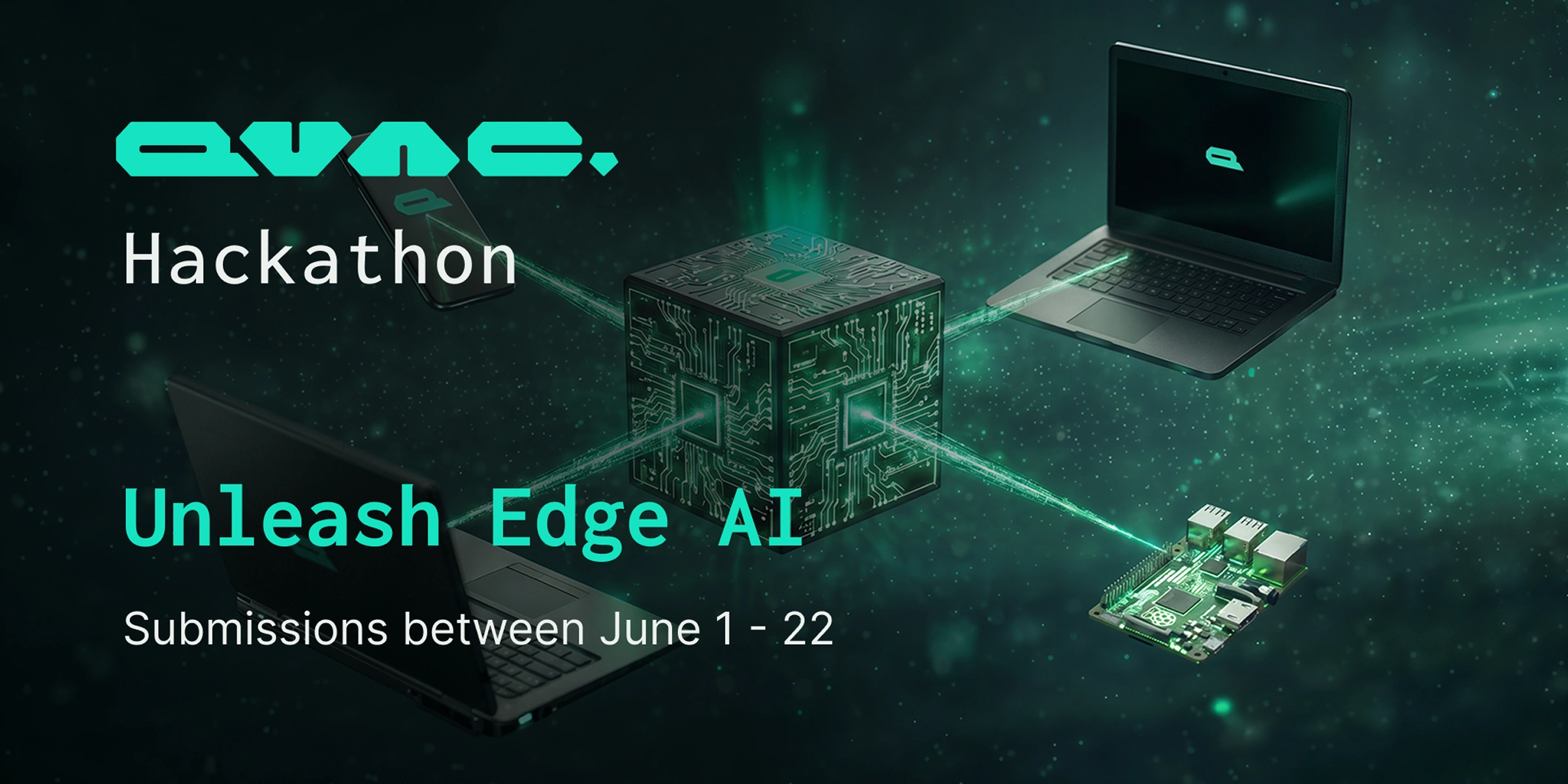
Welcome to QVAC Hackathon I, an official, month-long event designed to showcase the power of edge AI powered by QVAC. Running from May 25, 2026 through June 21, 2026, this online-focused hackathon is organized by the QVAC team at Tether. The goal is to prove that local-first, privacy-preserving, decentralised AI is production-ready today and can run entirely on consumer hardware with zero reliance on cloud services. Participants will build real applications using the QVAC SDK that operate on devices such as smartphones, laptops, and small single-board computers. The event emphasizes on-device inference, privacy, speed, resilience, and cost savings compared to centralized cloud solutions. Attendees range from developers and researchers to independent builders who want to ship tangible edge AI projects.
What it’s about
Using the QVAC SDK, a cross-platform JavaScript API for on-device inference, retrieval augmented generation (RAG), peer-to-peer model sharing, delegated compute, fine-tuning, and multimodal capabilities, contestants will create applications that run entirely on consumer hardware with no cloud dependencies. This hackathon is not a generic AI event; it seeks public demonstrations—by the community—that edge AI powered by QVAC can deliver privacy, speed, resilience, and cost savings that surpass centralized providers.
Build in Public!
A central theme is transparency and community involvement. Builders are encouraged to document and share their progress publicly, with a dedicated Build in Public track offering a USDT prize. Participants will post updates on social media and include hashtags to earn additional recognition and potential prize eligibility. The goal is to illustrate real-world progress and to inspire others to adopt on-device AI.
Tracks and Prizes
There are multiple tracks designed to reward different approaches to edge AI with their own prize pools in USDT. General Purpose devices cover consumer laptops and desktops, while the Tinkerer track targets ultra-low-power devices such as Raspberry Pi. The Mobile track focuses on retail-grade smartphones, and the Medicines track highlights MedPsy and related models. The competition emphasizes production-grade architectures, reproducibility, and the ability to demonstrate local inference and peer-to-peer capabilities. Each track has its own primary prize and potential honorable mentions, with additional bonuses for Build in Public efforts and early submissions.
How to participate
Participants will register via DoraHacks and must adhere to the QVAC participation requirements. Submissions must include a public GitHub repository, complete reproducibility instructions, a demo video, and a full evidence bundle for verification. Cloud APIs are prohibited for core workloads, emphasizing local execution. Submissions should clearly document hardware used, setup instructions, and artifact logs to enable thorough evaluation. The evaluation process comprises three stages: static repository analysis, artifact verification, and possibly a live action review. Early bird bonuses exist for submissions before a mid-June deadline.
What to expect
The hackathon fosters a vibrant community around local AI, privacy-first workflows, and open collaboration. Attendees will gain exposure to the QVAC ecosystem, including documentation, models on Hugging Face, and example repositories. There will be community engagement through Discord and social channels, and winners will be announced after the build period. This is a unique opportunity to contribute to the open local-AI ecosystem, connect with the QVAC team, and potentially form partnerships with Tether and related projects.
FAQ
This event is designed for developers and teams who want to demonstrate practical, on-device AI solutions using QVAC. Inquiries about tracks, submission requirements, and prizes can be directed to the official event pages and Discord channel. For those who want to learn more about on-device AI, privacy-preserving models, and edge compute, this hackathon provides a focused venue to explore these themes in depth.