Optimization Grand Challenge 2026
Overview
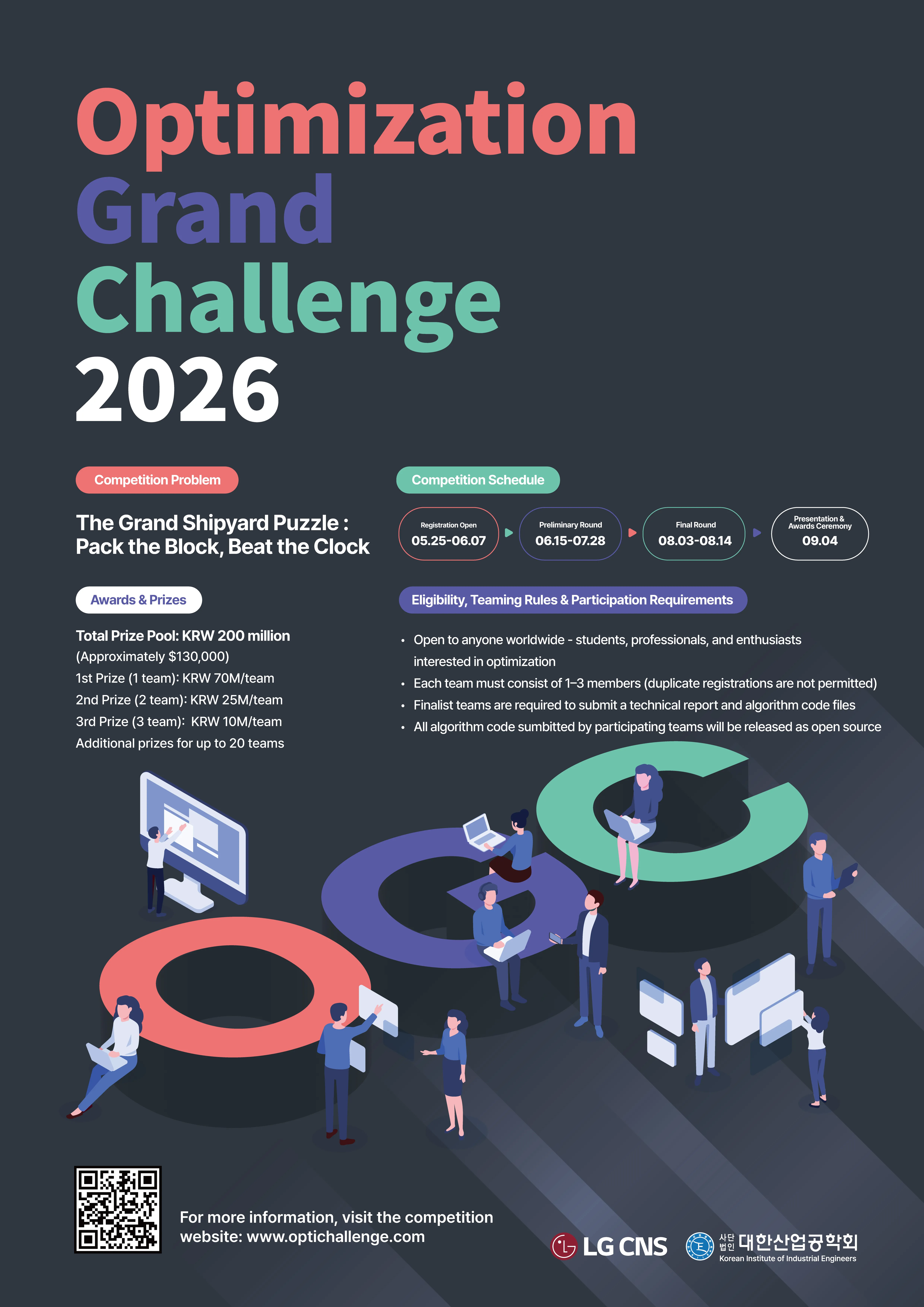
Optimization Grand Challenge 2026 (OGC 2026) is a global algorithmic optimization competition organized by LG CNS in collaboration with the Korean Institute of Industrial Engineers (KIIE). The challenge centers on solving a large scale packing and scheduling problem inspired by real world shipyard logistics. Participants are invited to develop efficient algorithms that can produce high quality solutions under time constraints. The event brings together teams from around the world to compete on a public platform with a total prize pool of KRW 200 million (approximately USD 130k). All times referenced on the page follow Korea Standard Time (UTC+09:00).
Get started
To participate, teams should form a group of 1–3 members and register their team. The competition has a two stage format consisting of a Preliminary Round and a Final Round. Submissions during the Preliminary Round are evaluated automatically on a competition server, with a leaderboard updating based on the results. The top 30–40 teams typically advance to the Final Round, where finalist teams must also provide a Technical Report and submission files. Final results are determined by a combination of automated scores, code verification, and presentation evaluation.
How the competition works
OGC 2026 comprises two stages: a Preliminary Round and a Final Round. Teams are free to use any methodology, including mathematical optimization, machine learning, heuristics, or a combination thereof. During the Preliminary Round, algorithm code is submitted for automated evaluation and the leaderboard is updated accordingly. The Final Round continues with automated scoring, and each finalist team must submit a Technical Report detailing their algorithm and results. Finalists also present their approach to the organizing committee.
Rounds and evaluation
The Preliminary Round involves code submission and automated scoring. Top teams advance to the Final Round, where the evaluation extends to the Technical Report and code review in addition to the automated scores. The Evaluation and Disclosure Policy states that specific evaluation criteria are at the organizers' discretion, individual results are not disclosed publicly, and all finalist submissions may be released as open source. Any misconduct discovered after final results can lead to prize revocation.
Prizes
The event offers substantial monetary rewards: 1st place awards USD 48,000, 2nd place USD 17,000 per team, 3rd place USD 7,000 per team, and additional prizes for teams ranking 4th through 20th. There are also internship opportunities with LG CNS for top winners. Prize amounts are denominated in USD for convenience and include considerations for wire transfer fees and taxes; exact USD equivalents may vary with exchange rates.
Dates and location
The official start and end dates listed for the event are May 24, 2026, through June 7, 2026, with the deadline and schedule posted in the page’s dates section. The event location is Seoul, South Korea, with the shipyard inspired puzzle and related competition activities taking place in a physical setting.
Who should attend
OGC 2026 targets researchers and practitioners in optimization, operations research, and algorithm design. Teams from all countries are welcome, with eligibility including minimum age requirements and team size constraints. For more details, refer to the official pages and rules linked on the challenge site.
FAQ
Common questions cover registration flow, team formation, submission guidelines, and how schedules align with time zones. The page notes that the top winners may receive additional benefits when applying to LG CNS and that all final code and technical reports may be made open source.
Sponsors and contact
LG CNS and KIIE are listed as organizers and sponsors, with the event supported by Devpost as the hosting platform. For inquiries, participants can contact the hackathon manager via the provided email address on the page.
Notes
This description consolidates the publicly visible goals, structure, and scheduling from the page in English. It reflects the two stage format, prize structure, and two key rounds while avoiding any unverifiable specifics beyond what is stated on the event page.
Event Details