
Overview
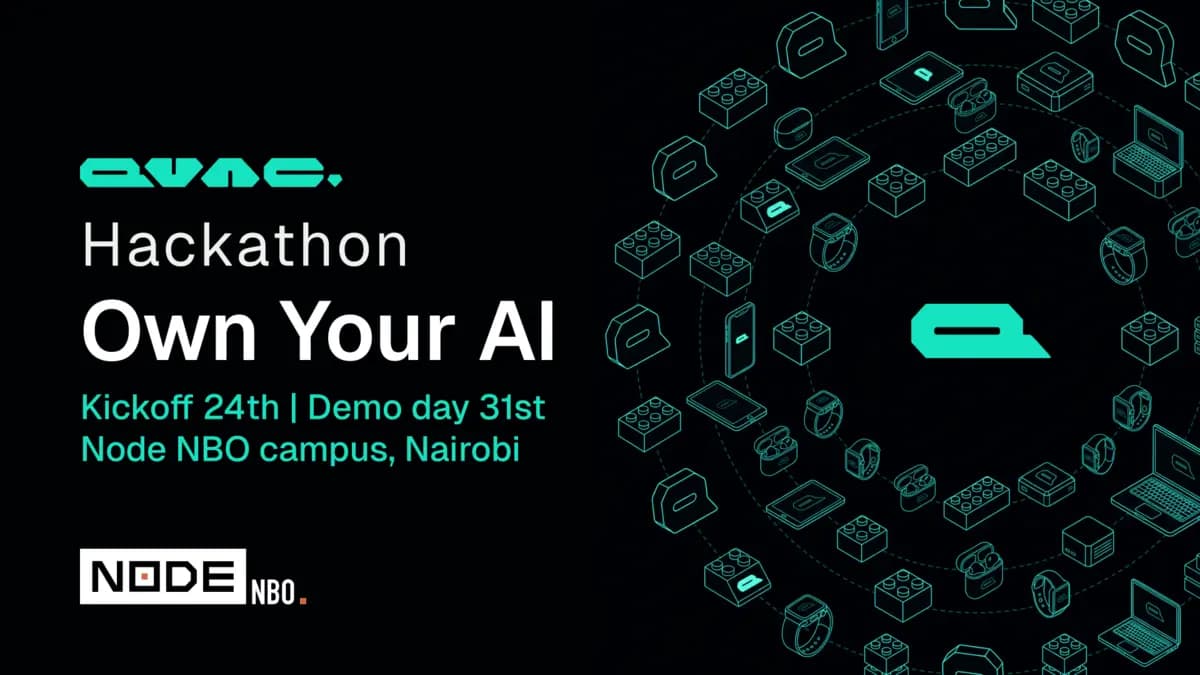
AI Yako, Swahili for "Your AI", is a one-week hackathon hosted by Tether with Node NBO in Nairobi, Kenya. Participants build useful applications with QVAC, Tether's local AI stack, where the AI runs on hardware the team controls. The theme is ownership: products whose core AI features keep working without an internet connection.
The event runs from 24 to 31 October 2026 at the Node NBO campus. All times are East Africa Time (EAT, UTC+3). Participants register for attendance on Luma, while project submissions and judging take place on the DoraHacks page. A Luma RSVP does not submit a project.
Tracks
Teams choose one of three tracks that best matches their project.
- Offline AI apps: Build a QVAC app whose core AI feature works without internet. Examples include a local assistant, speech tools, search, or translation. Live translation is a suggested topic, using models and languages supported on the target hardware.
- Cloud to Pocket: Move an existing cloud AI workload onto a device using QVAC. Teams explain the original workflow, what was moved, and the tradeoffs in quality, speed, memory, and privacy.
- On-device agentic finance: Combine QVAC local AI with WDK, Tether's Wallet Development Kit, for a self-custodial finance workflow. Offline AI must be clearly separated from any transaction or service that needs a network. The offline portion should be demonstrated safely with test data and a test environment.
QVAC must be used meaningfully in every entry. WDK is required for the finance track. Pears is welcome for device-to-device features.
Schedule
- Saturday 24 October, 09:00: Kickoff at Node NBO, with introductions, track briefs, QVAC setup, team formation, and a DoraHacks submission walkthrough.
- 25 to 29 October: Build week, with technical support and check-ins.
- Wednesday 28 October: Mid-week progress and offline testing check.
- Friday 30 October, 17:00: Project submission deadline on DoraHacks.
- Saturday 31 October, 09:00 to 17:00: Demo day at Node NBO, with offline demonstrations, judging, and awards.
What to submit
Each team submits one project through its DoraHacks Build. The submission should include a clear problem description, the target users, and the chosen track. It also needs a source-code repository on GitHub, GitLab, or Bitbucket with setup instructions, dependencies, and a note on what was built during the event. Existing code and third-party work must be disclosed.
A short demo video must show the working product with the internet disconnected. Teams also document the QVAC integration, including SDK and package versions, the model name, download steps, and the files where QVAC is used. Finance entries must explain the WDK integration. Submissions should list the device, operating system, memory needs, model licences, hardware limits, and any features that still need a network. Models should be downloaded before the offline demo. Private customer data, passwords, API keys, and wallet secrets must not be included. Repository and video links must be accessible to judges.
Judging
The core QVAC AI feature must run with the internet switched off. Projects that rely on a cloud AI API for that feature are not eligible for prizes. Network-dependent finance actions must be declared separately and cannot replace the offline AI demonstration. Judges assess real user value, meaningful QVAC integration, working implementation, usability, and the clarity and reproducibility of the offline demonstration. All reused work must be credited.
Prizes
The total prize pool is 3,500 USDt. The overall winner receives 1,500 USDt. The Cloud to Pocket track receives 900 USDt, the Offline AI apps track receives 700 USDt, and the Agentic finance with WDK track receives 400 USDt. Prizes are paid in USDt.
FAQ
Does a Luma RSVP submit a project? No. Projects must be submitted on the DoraHacks page before the deadline.
Can the core AI feature use a cloud API? No. The core QVAC feature must work offline, or the project is not eligible for prizes.
Is WDK required? Only for the on-device agentic finance track.
Where can teams get help? Teams can ask Victor through the DoraHacks page or use the organiser contact listed on the event page.