Overview
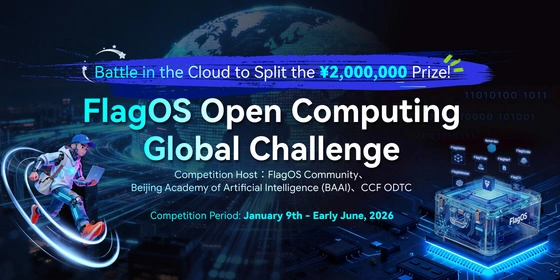
The FlagOS Open Computing Global Challenge is a multi-season competition jointly hosted by FlagOS Community, the Beijing Academy of Artificial Intelligence (BAAI), and the CCF Open Source Development Technology Committee (ODTC). The event encourages hands-on creation and exploration built on the unified AI software stack provided by FlagOS. It aims to advance the open computing ecosystem by inviting AI algorithm and system engineers, hardware and compiler developers, and other technical practitioners to participate. The competition features a substantial prize pool of 2 million RMB and offers official honorary certificates from the organizers. Season 1 is the inaugural phase, with registration opening in early January 2026 and final results announced in early June 2026. The program emphasizes three core tracks: Operator Development and Optimization, LLM Inference Optimization, and Automatic Data Annotation, all designed to improve large language model performance and efficiency while driving practical implementation and industrial innovation.
Tracks and focus
- Track 1: Operator Development and Performance Optimization Based on FlagOS. This track centers on the FlagGems operator library and 20 operator development tasks intended to test and push operator development and extreme performance optimization across six judging criteria: Functional Correctness, Performance Competitiveness, Open-Source Adaptability, Cross-hardware Compatibility, Test Case Completeness, and Code Readability.
- Track 2: Large Model Inference Throughput Optimization Based on FlagOS Multi-Chip Framework. Participants optimize inference performance for large models such as Qwen3-4B, balancing throughput, accuracy, and latency. Resources include the vllm-plugin-FL framework and the FlagGems library.
- Track 3: Automatic Data Annotation for Large Models in Long-Context Scenarios. This track focuses on In-Context Learning (ICL) based automatic annotation for long-context data using Qwen3-4B, with a standardized evaluation and leaderboard.
Schedule and phases
Season 1 registration runs from January 9 to May 20, 2026. The competition phases span Registration, Computing Resource Application (for Tracks 2 and 3), Computing Resource Review and Allocation, Development, Submission of Technical Reports and Source Code, Evaluation, and Early June results announcement. The detailed timetable covers track-specific milestones, including deadlines for resource requests, development windows, and final submissions. This structure ensures participants have clear timelines for experiments, testing, and reporting.
Prize structure
Track 1 offers Easy, Medium, and Hard operator tasks with prize tiers totaling up to 30,000 RMB for top placements plus smaller per-task rewards. Track 2 mirrors this with its own prize distribution for high-throughput inference tasks, aggregating significant sums for top teams. Track 3 also allocates prizes across stages and recognizes outstanding work in automated data annotation under long-context conditions. Overall, the prize pool and track-specific awards are designed to reward technical depth, innovation, and practical impact across operator development, large model inference, and data annotation.
Designated resources
Participants have access to key resources including the Large Model Inference Framework (vllm-plugin-FL), the FlagGems operator library, and the Qwen-3B to Qwen-4B family models. The competition emphasizes reproducibility and openness, with references to open-source repositories and community contributions.
Submission and guidelines
Submission requirements call for original, properly documented work adhering to official format guidelines for each track. Proposals, code, and reports should follow integrity standards, avoid disallowed content, and ensure compliance with intellectual property rules. Evaluation is track-specific, based on published criteria, with independent awards per track. Additional notes highlight the rights of organizers to use submitted work for promotion and public display, and the need for accurate information and fair competition practices.
Who should attend
This challenge is designed for AI researchers, system and hardware engineers, software developers, and practitioners who are excited by the intersection of AI software stacks and hardware acceleration. Whether you are focused on operator libraries, large-scale model inference, or long-context data annotation, this competition provides a platform to showcase skills, collaborate with peers, and gain recognition within the open computing community.
FAQ and contact
For questions, participants can reach out through the listed contact channels. The event emphasizes an open and collaborative spirit, inviting participants to contribute to the FlagOS ecosystem while pursuing excellence in open computing and AI software.