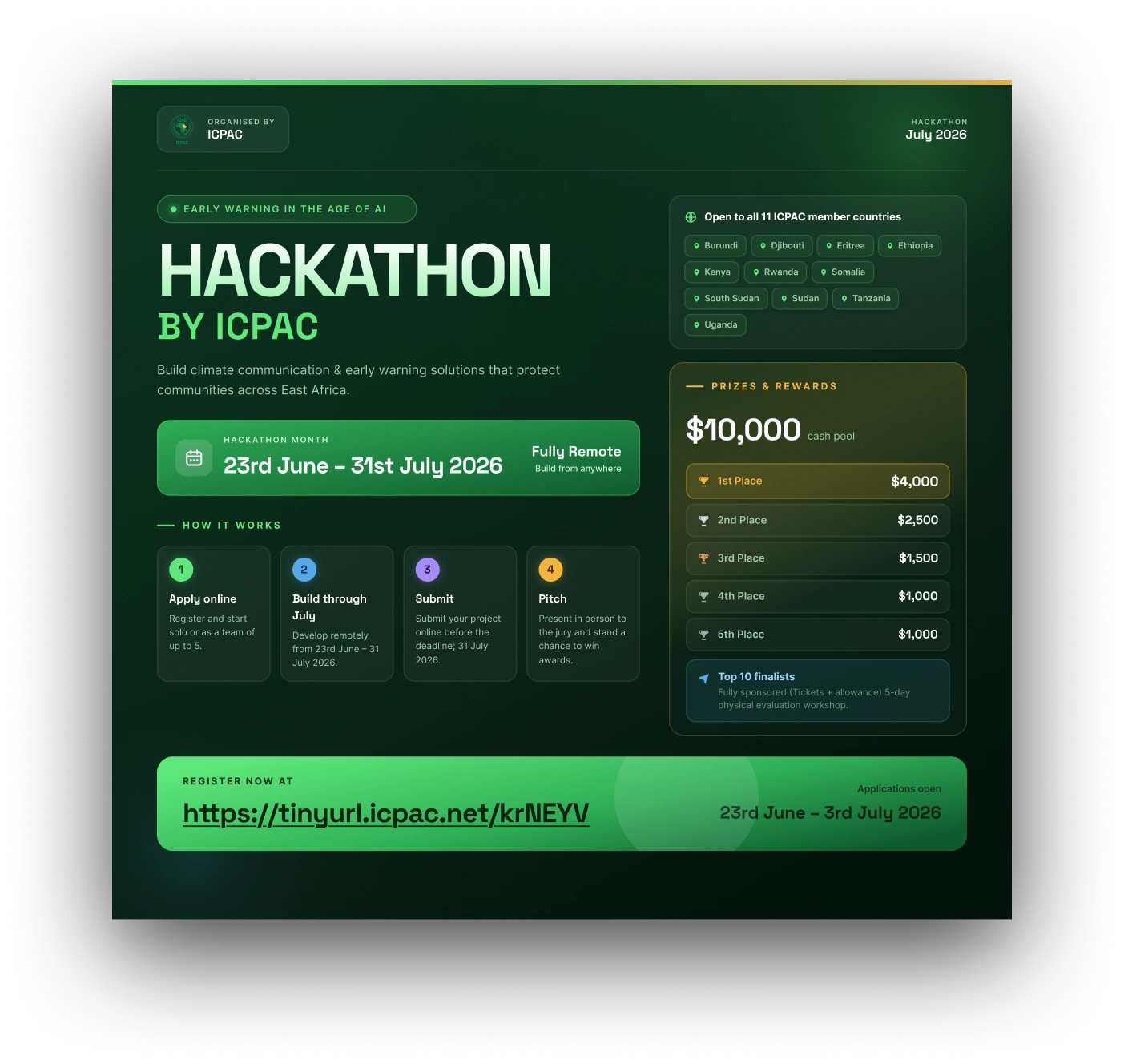
IGAD Hackathon 2026: Smarter Early Warning, Stronger Communities
Overview
The IGAD Hackathon 2026 is a regional software and technology challenge focused on transforming information into action to build safer, more resilient communities. Scheduled to run from late June to the end of July 2026, this event is set in Ngong, Kenya, and is described as an offline gathering with opportunities for developers, data scientists, technologists, and community innovators to collaborate on practical solutions for early warning and early action. Participants are encouraged to invent new approaches that improve how information is generated, communicated, understood, and transformed into timely interventions. The competition aims to strengthen resilience, support decision making, and improve outcomes for communities across the IGAD region.
What to expect
The hackathon welcomes a wide range of approaches including mobile applications, geospatial technologies, data analytics, AI driven tools, and community engagement platforms. Teams will design solutions that strengthen early warning systems and enable faster, more effective responses to climate and humanitarian risks. The event is positioned as more than a competition; it is a collaborative platform to contribute ideas that can influence policy and operational decisions affecting communities across the region.
Date and location
- Start: 2026-06-22
- End: 2026-07-31
- Location: Ngong, Kenya (address details on page point to Ngong, Kenya as the venue)
- Attendance mode: Offline event with on-site participation; the page lists an offline event attendance mode.
Format and agenda
The page emphasizes a competitive but collaborative format with a mix of sessions, workshops, and showcase opportunities. While explicit daily schedules or track names are not enumerated, the page references an on-page schedule view and a calendar integration feature. The event includes a challenge that asks participants to submit an innovative solution with sections such as Project Overview, Solution Details, Prototype, Technical Information, and more. Prizes are substantial, including cash rewards and fully sponsored participation in governance or regional evaluation activities. The description suggests a broad program with sessions, demonstrations, and possibly an evaluation workshop for top submissions.
Tracks, sessions, and speakers
The event page highlights a panel of judges and sponsors, including:
- MUBARAK MABUYA — Coordinator, IGAD IDDRISI/IGAD
- JULLY OUMA — Program Manager, Early Warning Systems, ICPAC
- JASON KINYUA — Lead Developer, ICPAC
- KEITH KORIR — Lead Developer, Bunifu Technologies
- UNIKA MUREITHI — Developer, Bunifu Technologies
- MOHAMMED ALI — Developer, ICPAC
- CRIMSON SIKOLIA — GIS Developer, ICPAC These names indicate a focus on regional organizations and technical expertise in early warning, GIS, and data systems. The page also lists partners such as ICPAC and Devpost, pointing to a blend of regional agencies and a platform for hackathon management and showcases.
Prizes and outcomes
Prizes include cash awards with a top prize of 4,000 USD, plus additional sponsored participation and prizes designed to support further development and evaluation. The prizes page outlines multiple placements and corresponding benefits, including participation in GHACOF74 and funded follow-up activities at a physical evaluation workshop.
Who should attend
The event targets developers, data scientists, designers, and innovators interested in disaster risk reduction, climate adaptation, and resilience-building through technology. It is suitable for teams and individuals seeking to contribute to early warning systems, risk communication, and decision support tools that can be deployed in real-world contexts across the IGAD region.
FAQs
- What is the focus of the hackathon? Transforming information into timely actions to improve safety and resilience for communities.
- Where is it held? Ngong, Kenya (off-line event).
- What can I win? Substantial cash prizes and opportunities for sponsored participation in follow-up workshops and events.
This event appears to offer a robust framework for collaboration, real-world impact, and regional cooperation around early warning and action.