Sinceerly: The New AI Tool that Aims to Humanize Your Writing
Published by AINave Editorial • Reviewed by Ramit
In an era increasingly dominated by AI-generated content, a new tool seeks to reverse this trend by inserting human touch into AI writing. Sinceerly, a Google Chrome extension, aims to transform polished AI-generated emails back into more human-like communication. This Chrome extension, which produces emails that include common human errors or adjusted language, highlights the growing skepticism towards AI authorship, notably hinted at by Hachette's recent decision to withdraw the controversial novel Shy Girl amid concerns over AI-generated writing.
The Functionality of Sinceerly
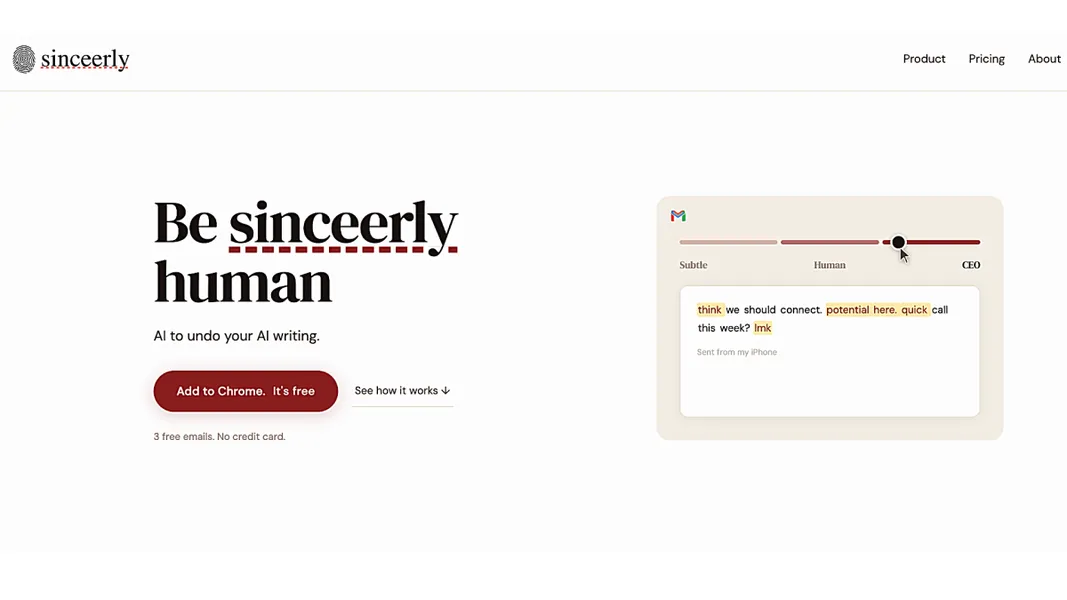
Sinceerly operates under a straightforward premise: it adds flaws typically scrubbed by AI writing tools. Users can choose from three modes — subtle, human, and CEO. The subtle mode introduces minimal errors, whereas the CEO mode presents text that lacks correct punctuation altogether, mimicking casual mobile communication. This third mode even appends the typical signature of a casual user, “Sent from my iPhone.” Such features allow users to retain their individuality in their digital communications amidst the ever-encroaching influence of AI.
A Priced Service to Perfect Human Communication
Initially, Sinceerly allows users three email rewrites for free before shifting to a subscription model priced at $4.99 per month. This paid option unlocks unlimited rewrites, instant switching between modes, and caching of the processed outputs. Ben Horwitz, a venture partner at Dorm Room Fund and the tool's creator, underscores the irony in having an AI tool to 'un-AI' writing. By functioning this way, Sinceerly serves as a mirror to the ongoing dialogue about the authenticity of online communication in 2026.
An Industry Reacts to AI's Growing Pains
The emergence of Sinceerly is not an isolated incident but rather part of a larger conversation about AI’s role in authorship and content creation. Just last month, Hachette, one of the major publishing houses, made waves by retracting the novel Shy Girl due to allegations about its AI origins. This decision signals a significant shift in how AI-generated content is perceived in publishing and other industries. Critics argue that such tools create a facade of authenticity while potentially leading to further complications in quality and originality.
Q&A: What prompted the development of Sinceerly?
The increase in AI-generated content raised alarms over its perceived lack of authenticity. Consequently, Horwitz spoke to this concern, illustrating that tools like Sinceerly provide a counterbalance, fostering a renewed sense of human touch in writing.
Q&A: How can Sinceerly change the way we communicate?
By promoting natural language and casual errors, Sinceerly positions itself as an essential tool for professional communication. It offers individuals the ability to maintain their unique voice, effectively bridging a gap between human expression and automated text generation.
Q&A: Is the future of writing purely AI-driven?
While AI continues to permeate various creative fields, tools like Sinceerly advocate for human involvement in writing processes. This tool not only alters perception but also emphasizes the importance of authentic expression in an increasingly mechanized world. Thus, a blend of both worlds may characterize the writing landscape moving forward.
Finding value in imperfection may well be the lesson of Sinceerly as it champions a return to a more genuine form of communication.