Scout AI Secures $100 Million to Revolutionize Military Autonomy with Innovative AI Training
Published by AINave Editorial • Reviewed by Ramit
Scout AI Secures $100 Million to Revolutionize Military Autonomy with Innovative AI Training
Scout AI has raised $100 million in a Series A funding round led by Align Ventures and Draper Associates, aiming to transform military operations through its advanced AI training program. Founded in 2024 by Coby Adcock and Collin Otis, Scout AI focuses on creating intelligent models designed for the battlefield, while successfully securing $11 million in contracts with the Department of Defense (DoD).
The Military-Grade AVs at Work
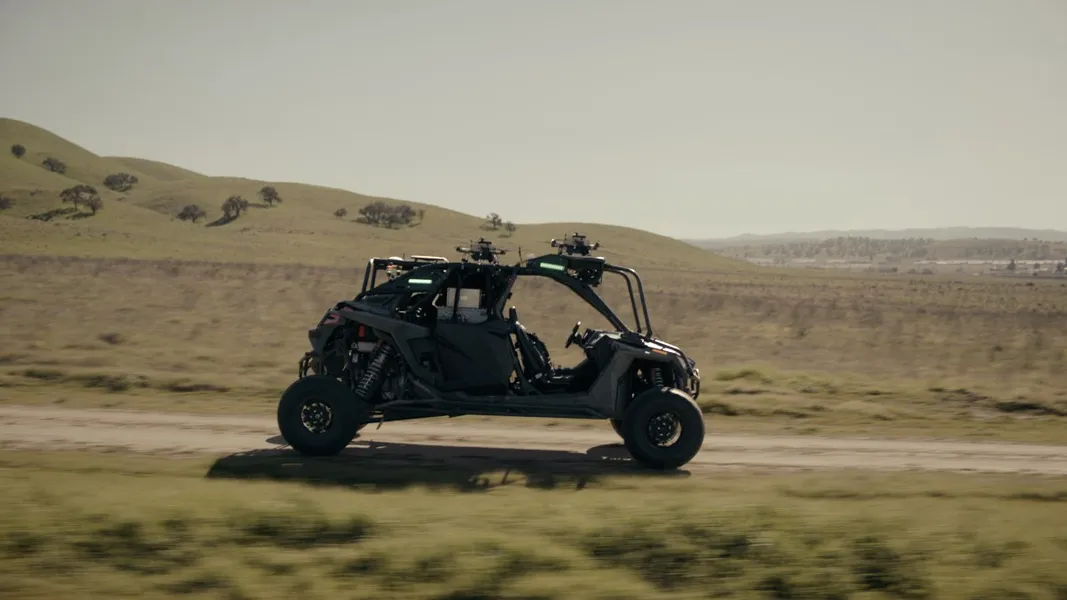
The central operation for Scout AI takes place at a military installation in central California, where autonomous four-seater all-terrain vehicles are tested in rugged terrain. This training serves not just for the machines but to perfect AI deployment in conflict zones. These tests are integral to the Scout's vision of a future where AI models lift the burden off soldiers by managing logistical operations and potentially autonomous weapon systems, echoing a traditional strength of military logistics but innovatively enhanced with technology.
The company has also made strides in securing military technology development contracts worth over $11 million, collaborating closely with DARPA and the Army Applications Laboratory. As part of the testing cycle, these vehicles undergo rigorous training meant to prepare them for real-world deployment expected by 2027.
What Makes Scout AI’s Approach Unique?
Scout AI utilizes Vision Language Action (VLA) models, a technology building on existing large language model (LLM) frameworks. Unlike conventional autonomous vehicles operating under structured environments, Scout’s ATVs navigate unmarked, rugged trails, posing significant operational challenges. CTO Collin Otis's experience in autonomy technology propels this initiative; he previously worked on AI systems that lacked the adaptability needed in unpredictable war settings.
“The technology is good enough to be doing that experimentation in the field with soldiers,” states Stuart Young, a former DARPA program manager. Successfully integrating AI into military operations involves not only facilitating human-machine collaboration but also prioritizing safety precautions in autonomous decision-making.
Addressing Ethical and Operational Concerns
Despite the promising advancements, ethical considerations surrounding autonomous weapons development remain critical. Jay Adams, a retired U.S. Army Captain at Scout, insists that responsible programming—and human confirmation—are vital to prevent unintended consequences in combat scenarios.
Otis argues that current technologies could greatly enhance targeting efficiency while maintaining human oversight. He distinguishes between old and new warfare technologies, framing autonomous weapon systems as a natural evolution in military capabilities rather than merely raising alarm bells in the defense tech community.
The Path Forward
Scout envisions itself primarily as a software company, designed to overlay intelligence capabilities onto existing military hardware. Their flagship product, “Ox,” is aimed at enabling soldiers to command multiple drones and vehicles with intuitive commands. However, effectively launching such a product hinges on comprehensive training with operational vehicles, a cornerstone of Scout's mission.
As developments unroll, the company plans to further refine its autonomous capabilities. “[VLAs] will enable us to build a broader universe of intelligent models,” notes Otis, presenting a vision where their models will not only learn from simulations but continuously adapt by interacting with the real world.
In a market bustling with uncertainties, Scout AI stands at a precipice between innovation and ethical ramifications, aspiring to bring military autonomy into a new era while addressing concerns that accompany such advancements. Balancing technological progress with moral responsibility will be paramount as this venture moves forward.