LineShine CPU-only supercomputer tops TOP500, signaling domestic chip ecosystem ambitions amid AI race
Published by AINave Editorial • Reviewed by Ramit
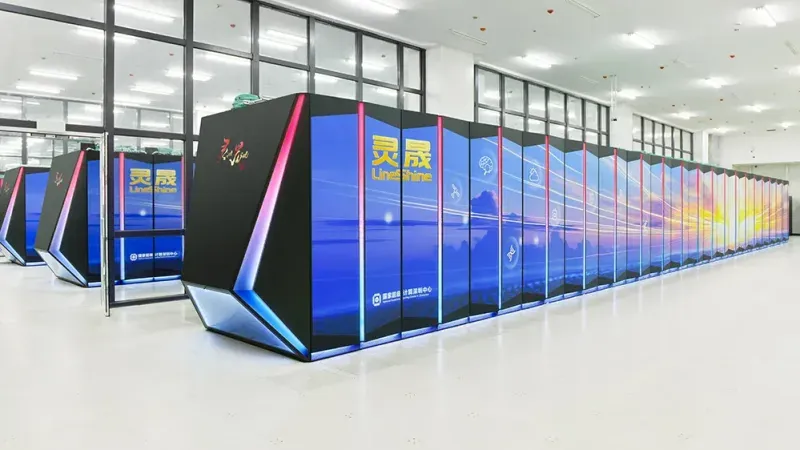
China's LineShine supercomputer at the National Supercomputing Center in Shenzhen has overtaken the US El Capitan to become the world's top-ranked system on the biannual TOP500 list, achieving roughly 20% higher computing speed than the American machine. What makes this milestone stand out for AI builders is the machine's architecture: LineShine runs entirely on domestically developed CPUs and high-bandwidth memory (HBM), with no reliance on GPUs. This approach emerges from US export restrictions that have cut off China's access to advanced GPU technology since 2022, forcing hardware innovation around domestic silicon. But before you read this as a direct signal for AI infrastructure, experts warn that the TOP500 benchmark measures traditional HPC workloads and may not reflect modern AI capability.
What happened
LineShine replaced the American titleholder El Capitan at the Lawrence Livermore National Laboratory in the latest TOP500 ranking announced in June 2026. The machine achieved a 2.198 exaflops sustained double-precision HPL performance, roughly 20% faster than El Capitan. This marks the first time since 2017 that a Chinese system has held the top spot on the list.
LineShine chief designer Lu Yutong said the system broke through the conventional hybrid CPU-GPU architecture by using a full-stack domestically developed computing infrastructure, including CPUs and high-bandwidth memory. The system reportedly uses around 47,000 CPUs and targets 2 exaflops at full deployment. China's National Supercomputing Center called LineShine the result of breakthroughs across a series of core technological bottlenecks, marking a historic leap in overcoming foreign technology restrictions and building an independently controlled hardware and software ecosystem.
Since its launch, LineShine has been used for climate modeling, engineering simulations, drug discovery, neuroscience, and AI workloads.
Why AI builders should care
For AI builders, the immediate takeaway is not a new inference engine or training cluster to evaluate. The LineShine milestone is more relevant for understanding shifts in hardware supply chains and the growing viability of domestic chip ecosystems under export restrictions. As US GPU export controls tighten, the ability to achieve top-tier HPC performance with CPU-only systems signals that the hardware stack for scientific and AI workloads may diverge between regions.
However, the TOP500 ranking is a poor proxy for AI capability. Andrew Rohl, director at the National Computational Infrastructure in Australia, told reporters that "the TOP500 is based on a decades-old benchmark designed to measure traditional scientific computing workloads instead of modern AI." He also noted that many of the most powerful AI systems from US companies such as xAI and Google, or supercomputers run by defense facilities, do not enter the ranking for sensitivity or economic reasons. That limits the list's value for cross-comparison of AI infrastructure.
Practical implications
The LineShine example underscores a broader trend: hardware autonomy as a strategic priority. AI builders should expect more domestically developed chip solutions to emerge, particularly for HPC workloads that overlap with AI training and simulation. The system's workload range includes AI alongside traditional HPC tasks, suggesting that future CPU-only or CPU-heavy architectures may handle a wider slice of AI infrastructure than before, especially in markets restricted from GPU access.
Caveats
Experts caution against overinterpreting the ranking as a measure of national AI competitiveness. The TOP500 benchmark (HPL) does not measure training throughput, inference latency, or the mixed-precision performance that modern AI workloads require. The LineShine system's real-world AI performance remains unclear from the available sources. Additionally, US export controls currently target GPU technology; some analysts argue that CPU export controls may also need tightening to maintain technological advantage.
FAQs
Sources
- Chinese supercomputer powered by homegrown chips tops US models in global ranking
- Chinese Supercomputer Displaces US Machines as World's ...
- In supercomputer marathon, China tops US; but AI-high? No
- Chinese supercomputer leapfrogs best US machines to be ranked ...
- LineShine: All-CPU Chinese supercomputer named world's most ...
- China unveils 2-exaflop LineShine supercomputer built on domestic chips
- China unveils CPU-only supercomputer aiming to surpass US El Capitan
- China unveils LineShine supercomputer with 47,000 CPUs, targets 2-exaflop scale
- China Beats US With World's Fastest Supercomputer, but Race ...
- China beats US with world's fastest supercomputer, but race ...
- China's 'Lingsheng' Supercomputer Tops Global Rankings After ...
- China Tops US in Supercomputer Race - tech.yahoo.com
- DeepSeek unveils new AI model tailored for Huawei chips as China pushes for tech autonomy
- Chinese supercomputer displaces US machines as world's fastest
- Chinese supercomputer powered by homegrown chips tops US models in global ranking