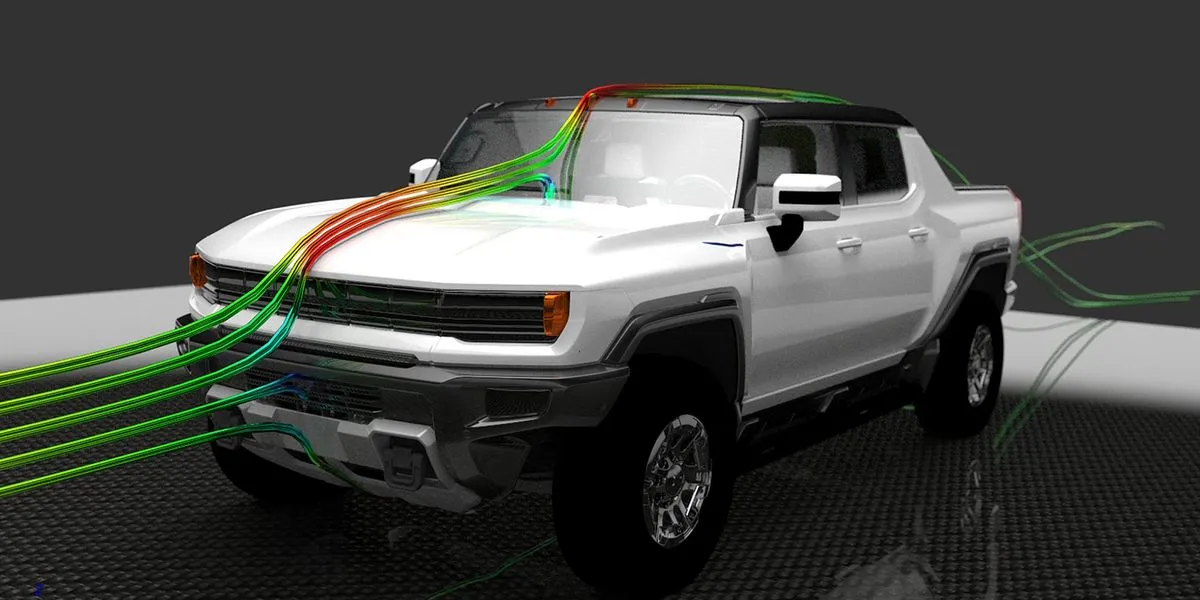
GM AI-driven vehicle design halves development time with virtual calibration and simulation
Published by AINave Editorial • Reviewed by Ramit
General Motors is betting that AI and physics-based simulation can collapse vehicle development timelines from the traditional four to five years down to about two years, matching the pace set by Chinese automakers like BYD. The effort is led by Sterling Anderson, the former Tesla Autopilot and Model X leader who joined GM as chief product officer in 2023 with a $40 million package to overhaul how cars, batteries, software, and autonomous systems are designed and validated.
What happened
GM has adopted a simulation-driven design approach that lets engineers run thousands of virtual scenarios before any physical prototype is built. The company reports that this method halved the development time of the GMC Hummer EV, which went from initial designs to showroom in two years compared to a more typical four- to five-year cycle. Jason Fischer, GM's executive director of virtual integration engineering, says the company can now perform full virtual calibrations for systems like powertrain, brakes, steering, and suspension prior to building a single physical vehicle.
One of the most striking efficiency gains is in crash simulation. A front-end crash computation that previously required 15 hours of processing now completes in less than one minute using an AI probabilistic method. This speed lets engineers probe edge cases that would be impractical or unsafe to test physically. Anderson notes that GM is running roughly 2 million simulation runs per week and can simulate 100 days of driving in a single day.
The AI-driven design pipeline extends beyond cars. GM is applying it to autonomous vehicle development, Cadillac's Formula 1 program, military defense systems, and the Lunar Outpost Pegasus rover for NASA's Artemis mission. Engineers in Michigan can alter gravity in software to simulate lunar conditions and develop tires for the moon's surface.
AI is also reshaping component design. For the Chevrolet Corvette, generative physics-based design produced a rear hatch support bracket that is lighter, stiffer, and more durable than the original, with a shape resembling a tree root and branches.
Why AI builders should care
GM's approach is a real-world example of how AI and simulation can collapse traditionally siloed engineering disciplines into a single virtual workflow. Anderson describes three historical epochs: empirical design, the advent of CAD and computational fluid dynamics in the 1950s, and now an AI-driven third epoch where functions like structural engineering, thermal controls, safety, and ride handling are developed and optimized simultaneously. For builders shipping complex hardware-plus-software products, the lesson is that integrating AI-based simulation early can dramatically shorten iteration cycles.
The use of driver-in-the-loop simulations with human personas (e.g., a Boston driver in January vs. a Phoenix driver in summer) demonstrates how synthetic behavioral data can inform design before any physical prototype exists. This pattern is directly relevant to teams building autonomous systems, robotics, or any product that must handle diverse real-world conditions.
Practical implications
AI-driven design practices can reduce time-to-market for complex engineered products. GM's ability to run 2 million simulations per week and detect weak spots earlier means fewer expensive physical prototypes and fewer late-stage redesigns. The sub-minute crash simulation turnaround allows engineers to try many more design variations, increasing the probability of finding optimal tradeoffs between weight, strength, and cost.
For AI builders, the pipeline points to opportunities in creating simulation platforms, physics-informed ML models, and virtual calibration tools for domains beyond automotive-from aerospace to industrial equipment.
Caveats
The source evidence for this article is limited to a single IEEE Spectrum piece. The reported development time reductions and simulation speeds are GM's claims, not independently verified. The article does not disclose GM's exact investment or ROI from the AI initiative. Future outcomes, such as the Artemis lunar rover timeline, are described as ambitions rather than confirmed milestones.
It is also unclear how broadly these AI methods have been deployed across GM's full vehicle lineup beyond the Hummer EV and Corvette bracket. Anderson himself said, "We're not there yet, but give us a minute", indicating the company is still scaling the approach.
FAQs
How does GM use AI to speed up car design and development?
GM uses AI-driven design and simulation to run thousands of virtual scenarios before any physical prototype is built. This enables faster hardware-software co-design and full virtual calibrations of vehicle systems.
Who is Sterling Anderson and what is his role at GM?
Sterling Anderson is a former Tesla Autopilot and Model X leader who joined GM as chief product officer in 2023 with a $40 million package. He leads the development of GM's cars, autonomous models, batteries, and software.
What are virtual calibrations and how do they help GM's design process?
Virtual calibrations are comprehensive software-driven validations that adjust and test a vehicle's systems in a simulated environment before real-world prototyping, improving the readiness of designs.
How many simulations does GM run per week and what is the impact on time to market?
GM reports roughly 2 million simulation runs per week, contributing to shortened development cycles such as the Hummer EV's two-year timeline from initial design to showroom.
What projects involve AI-driven design for cars like the Hummer EV or Corvette?
The article discusses the GMC Hummer EV, Chevrolet Corvette hatch brackets, and NASA lunar rover work as examples of AI-driven design applications.
How is AI used in NASA lunar rover work at GM?
AI-driven simulations are used to model lunar conditions, adapt tires and systems for lunar gravity, and accelerate iterative design for the Pegasus rover program under NASA's Artemis mission.