ASML's Surge in EUV Lithography Production Set to Transform AI Chip Market
Published by AINave Editorial • Reviewed by Ramit
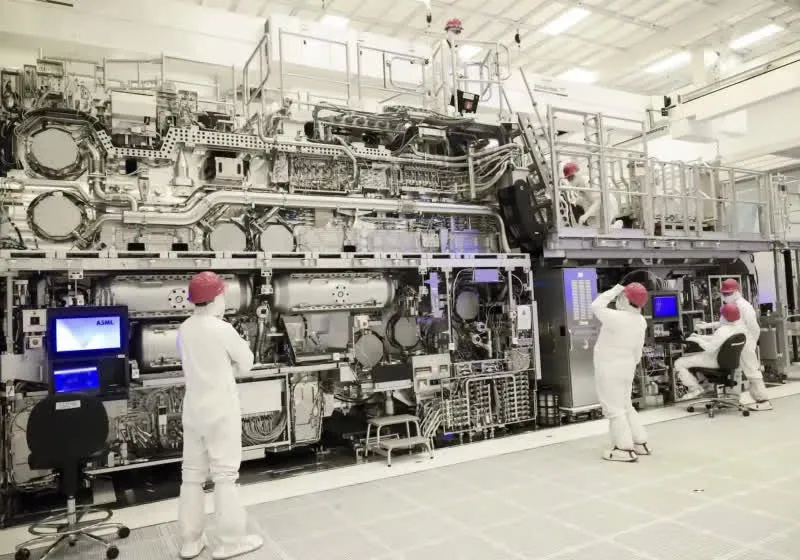
ASML, a key player in the semiconductor manufacturing industry, is ramping up production of its extreme ultraviolet (EUV) lithography systems, driven by unprecedented demand in the artificial intelligence (AI) sector. The company aims to produce at least 60 EUV machines this year, with an ambitious plan to increase output to at least 80 annually as it addresses the rapidly evolving needs of AI infrastructure. With a commitment to invest approximately $2.2 billion in capital expenditures this year, ASML is not only reconfiguring its facilities but also expanding cleanroom capacity across the US, Germany, and South Korea, as well as constructing a new campus near its Dutch headquarters.
The Demand Surge
The escalation in AI chip demand is underscored by ASML's expectation of generating annual sales between $42 billion and $47 billion. This revenue growth reflects broader trends across the semiconductor industry, spurred by major technology firms' investment in AI-related hardware. However, ASML faces challenges; the need for customers to create adequate cleanroom environments and secure sufficient power to operate these complex machines often delays production scalability.
Addressing Production Constraints
ASML's EUV systems represent some of the most technologically advanced equipment in the semiconductor landscape. Each unit's assembly is a highly meticulous process that extends over several months, involving numerous components sourced from a vast supplier network. This complexity means that even a minor disruption, such as a particle of dust, can impede production. To tackle this, the company is increasing collaboration with suppliers through enhanced oversight, which includes regular check-ins aimed at preventing delays in the supply chain. Such coordination is pivotal, as missing parts can stall the final assembly of EUV machines, thereby affecting overall output.
Future Investments and Innovations
ASML is also focusing on upgrading its existing systems to enhance their performance and throughput. Though the next-generation high-numerical-aperture (High-NA) EUV systems offer improved resolution and efficiency, the significant investment required has led to hesitation among some chipmakers who prefer to maximize their current technology.
Investments in workforce development are also essential; ASML is hiring and training engineers to confront labor shortages. With cleanroom expansion and extensive infrastructural upgrades underway, the company is preparing for a future where chip designs continue to shrink, necessitating increasingly sophisticated lithography processes.
Continued improvements in light source technologies remain a long-term goal for ASML, as these enhancements are fundamental to achieving greater throughput performance in the face of increasing manufacturing demands. Despite previously signaling potential slowdowns in production, ASML's strategies reveal confidence in navigating the multifaceted challenges of the semiconductor market.
Ultimately, as ASML strives to keep pace with the soaring demand for advanced AI chips, its immediate investments and long-term innovations position it to play a critical role in shaping the future of semiconductor manufacturing.